buyer guide · Wholesale buying & supplier assessment
Ten Practical Benefits of B2B Ecommerce for African Businesses

1. Discover suitable Kenyan products without travelling to every supplier
By Dr. Chomba Chuma, Founder, Viwanda.
Wholesale sourcing often begins with a practical problem: you know what your customers need, but not who makes it nearby. A shop owner in Nakuru, a hotel buyer in Kisumu or a hardware dealer in Machakos may spend valuable working hours following referrals that do not fit the requirement.
B2B ecommerce gives that search a clearer starting point. Product pages and supplier profiles can bring scattered information into one place. You can identify possible Kenyan manufacturers, study their product ranges and decide whom to contact before paying for travel or arranging a meeting.
The benefit is not that every listing becomes a suitable supplier. It is that you can eliminate obvious mismatches earlier. A business selling household cleaning products may be irrelevant to a buyer seeking industrial cleaning inputs, even when both appear under a broad cleaning category.
Begin with the job the product must do. Record the material, intended customer, pack format and any essential performance requirement. Then browse Kenyan-made products using that description rather than searching only for the lowest advertised amount. Specific needs produce more useful supplier conversations.
Discovery should still lead to a real exchange. Ask whether the listed product is currently available, made to order or supplied through an authorised channel. For customised goods, request a sample or specification before committing. Online discovery works best when it reduces unnecessary journeys while preserving the conversations and physical checks that matter. It should make your next visit more purposeful, not persuade you that every visit is unnecessary.
2. Turn a vague request into a useful wholesale enquiry
A second benefit is better communication at the beginning of an order. Messages such as send your best price leave too much unanswered. The supplier cannot tell whether you want a sample, a carton, repeat supply or a product made to your own specification.
A structured digital enquiry makes those details easier to capture and share. It also helps a colleague continue the discussion if the original buyer is away. Instead of starting again, the supplier and purchasing team can work from the same written requirement.
For a Kenyan shop, institution or distributor, a useful enquiry should cover the points below. Exact requirements vary by product, but the aim is always to remove avoidable assumptions before the quotation arrives.
- Describe the product, material, size or grade, including any acceptable alternatives.
- State the quantity and unit clearly: pieces, packs, cartons, kilograms or another agreed measure.
- Give the delivery or collection location and explain any access restrictions.
- Explain when the goods are needed, while asking the supplier to confirm feasibility.
- Request payment terms, quotation validity and any relevant product documentation.
3. Compare complete offers instead of misleading headline prices
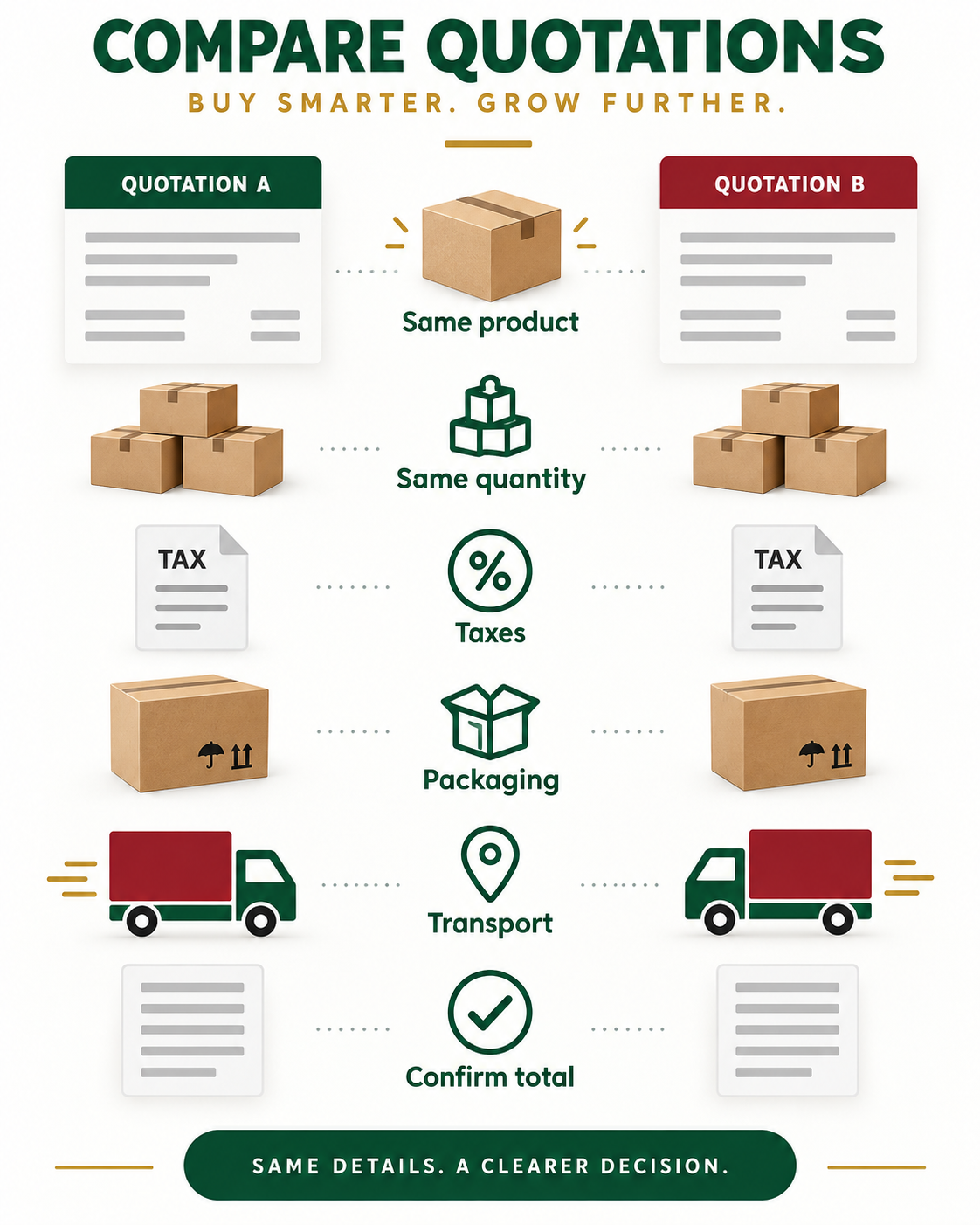
Price visibility is useful, but a visible number is not automatically a comparable offer. One supplier may quote per piece while another quotes per carton. One amount may include transport, while another covers collection from the factory. Tax treatment and packaging can also change the final payable amount.
B2B ecommerce can help by keeping product descriptions and written offers close together. The buyer can build a simple comparison using the same specification, quantity and destination. The benefit comes from organising the information, not from assuming that online prices are always lower.
Consider two offers for locally manufactured storage containers. Before choosing, check capacity, material, lid type and carton contents. A cheaper container that does not meet the customer's intended use is not a saving. An apparently higher offer may cover requirements that the other leaves out.
Ask each supplier to identify what is included and excluded. Confirm the applicable taxes, packaging charges, transport responsibility and whether the amount changes with quantity. Where an offer is provisional, record what must happen before it becomes firm, such as approving a sample or confirming material availability.
Keep the quotation date and validity alongside the total. An old screenshot should not become the basis of a new purchase without confirmation. If an invoice or tax question is unclear, use official KRA guidance or seek qualified advice rather than relying on assumptions shared in a group chat.
The practical result is a defensible buying decision. You can explain why one offer meets the requirement better, even when it is not the cheapest. That clarity matters when an owner, accountant or purchasing committee later reviews the order.
4. Make supplier assessment more focused and proportionate
Finding a supplier online does not remove the need for assessment. It changes where assessment begins. A useful profile can help you prepare questions about production, product suitability and trading arrangements before requesting documents or visiting the premises.
This is especially helpful when several people participate in purchasing. They can review the same product information and record unresolved questions. However, a polished page, attractive photograph or quick reply should never be treated as proof of manufacturing capacity or regulatory compliance.
Start by understanding the seller's role. Are you dealing with the manufacturer, a distributor or another authorised seller? Each can be a legitimate route to supply, but their control over specifications, production schedules and after-sales decisions may differ.
For goods subject to standards or certification requirements, ask which requirements apply and how the relevant details can be verified. KEBS is the official starting point for Kenyan standards and certification information. A mark shown in a photograph should not replace checking the details appropriate to that product.
The depth of assessment should match the consequence of getting the order wrong. A routine purchase of familiar goods may need less investigation than safety-related equipment, customised packaging or an unfamiliar product intended for institutional use. Ask for samples, technical information or a visit where the risk justifies it.
You can use manufacturer listings to begin a shortlist, then record what has actually been confirmed. Separate supplier statements from documents reviewed and samples tested. That simple distinction prevents a promising introduction from being mistaken for an approved supply relationship, and gives your team a clear basis for deciding what to check next.
5. Reduce repeat administration without losing necessary checks
Wholesale buying involves more than selecting a product. Someone must request an offer, clarify the specification, obtain approval and communicate the final requirement. When these tasks live across personal phones and loose notebooks, the same questions can be answered several times.
A digital enquiry trail can reduce that repetition. Previous specifications and supplier responses provide a starting point for the next purchase. Even without specialist software, a shared folder and consistent order reference can make information easier to find and hand over.
The important distinction is between reusing information and assuming nothing has changed. Availability, payment instructions, materials and lead times can change between orders. Keep the stable details, but ask the supplier to reconfirm the commercial terms that apply to this purchase.
Use the following sequence as a basic purchasing routine. It can support a small owner-managed shop or a larger team with separate buying and accounts roles.
- Prepare one written requirement with the product specification, quantity, destination and intended use.
- Send the requirement to suitable suppliers and keep their responses under one enquiry reference.
- Clarify differences, request missing information and obtain a complete written quotation.
- Get the necessary internal approval before accepting terms or making a payment.
- Confirm the order, agreed payment arrangement and fulfilment responsibilities in writing.
- Save the final documents and note which details must be reconfirmed for a repeat purchase.
6. Match the order to the right manufacturing or distribution channel
Buying directly from a factory is not automatically the best choice for every business. A manufacturer may organise production around larger runs, while a distributor may hold a wider assortment in quantities that suit smaller buyers. The useful question is which channel fits your actual requirement.
B2B ecommerce can make these options easier to discover. Instead of forcing every enquiry through the first contact you find, you can identify whether production supply, stocked distribution or a combination is more appropriate. That can prevent lengthy discussions with a seller whose operating model does not match yours.
For example, a business commissioning a branded product may need direct access to manufacturing decisions. A neighbourhood retailer seeking a mixed order of established products may find an authorised distributor more practical. Neither route guarantees better pricing; both require a complete offer.
Ask who will quote, invoice, receive payment and resolve product questions. If the manufacturer refers you to a distributor, confirm the relationship and continue the commercial discussion with the party actually supplying the goods. Clear roles reduce the chance of receiving conflicting instructions.
Explore distribution contacts alongside manufacturing options where appropriate. Ask about product coverage, minimum quantities, collection arrangements and whether all requested lines can be supplied together. Do not assume a distributor stocks every item made by a manufacturer.
This benefit is about fit rather than cutting someone out of the transaction. A well-chosen intermediary can perform useful work through stockholding, assortment and local service. A direct manufacturer relationship can support detailed specifications. Your task is to understand the responsibilities and choose the route that serves the order.
7. Coordinate fulfilment before the goods are ready
An order is not complete when the supplier accepts it. Goods still need to be prepared, collected or transported, received and checked. Digital communication can help connect these stages, especially when the buyer, supplier and transporter work from different locations.
The advantage is earlier coordination, not an automatic promise of faster delivery. A clear record can show whether goods are available from stock or need production, who is arranging transport and what information the receiving team needs. Each commitment should be confirmed by the responsible party.
In Kenya, a destination described only as town or market can create avoidable confusion. Share a precise location, receiving contact and practical access details. A delivery to a shop upstairs is different from collection at a loading bay, even when both addresses are in the same building.
- Confirm whether the order will be collected or delivered, and who appoints the transporter.
- Agree how goods will be packed, counted and identified before handover.
- Record any loading, unloading or vehicle-access requirements at both ends.
- Ask how readiness, dispatch and changes to the arrangement will be communicated.
- Confirm the receiving documents and the process for reporting discrepancies.
8. Build a purchasing record that improves repeat orders
Many purchasing decisions are made from memory. A buyer recalls that one supplier was helpful or that another order caused problems, but cannot find the detail. B2B ecommerce can support better records by preserving enquiries, specifications and commercial discussions in a form that can be reviewed.
Those records become useful when they capture outcomes, not just messages. After receiving an order, note whether the product matched the agreed specification, whether the quantity was correct and whether communication was clear. Record factual observations rather than broad labels such as good or unreliable.
A short review can reveal that a problem began inside your own business. Perhaps the enquiry used the wrong unit, the receiving contact was unavailable or approval came later than expected. Better records help separate supplier performance from buyer-side mistakes.
Use that information to improve the next enquiry. Add a photograph of the approved product where helpful, preserve the correct product code and identify any agreed packaging requirement. Reconfirm current availability and terms rather than treating the previous order as a standing promise.
These records also support continuity when staff change. A new buyer should not have to rebuild every supplier relationship from a former employee's phone. Keep business documents in an authorised shared location, limit access appropriately and avoid circulating sensitive payment or personal information unnecessarily.
Over time, the benefit is a more informed purchasing routine. You can see which suppliers suit particular categories and which requirements repeatedly need clarification. A small business does not need a complex dashboard to gain this advantage; consistent notes tied to real orders can already make the next decision better.
9. Prepare for African trade without confusing discovery with readiness
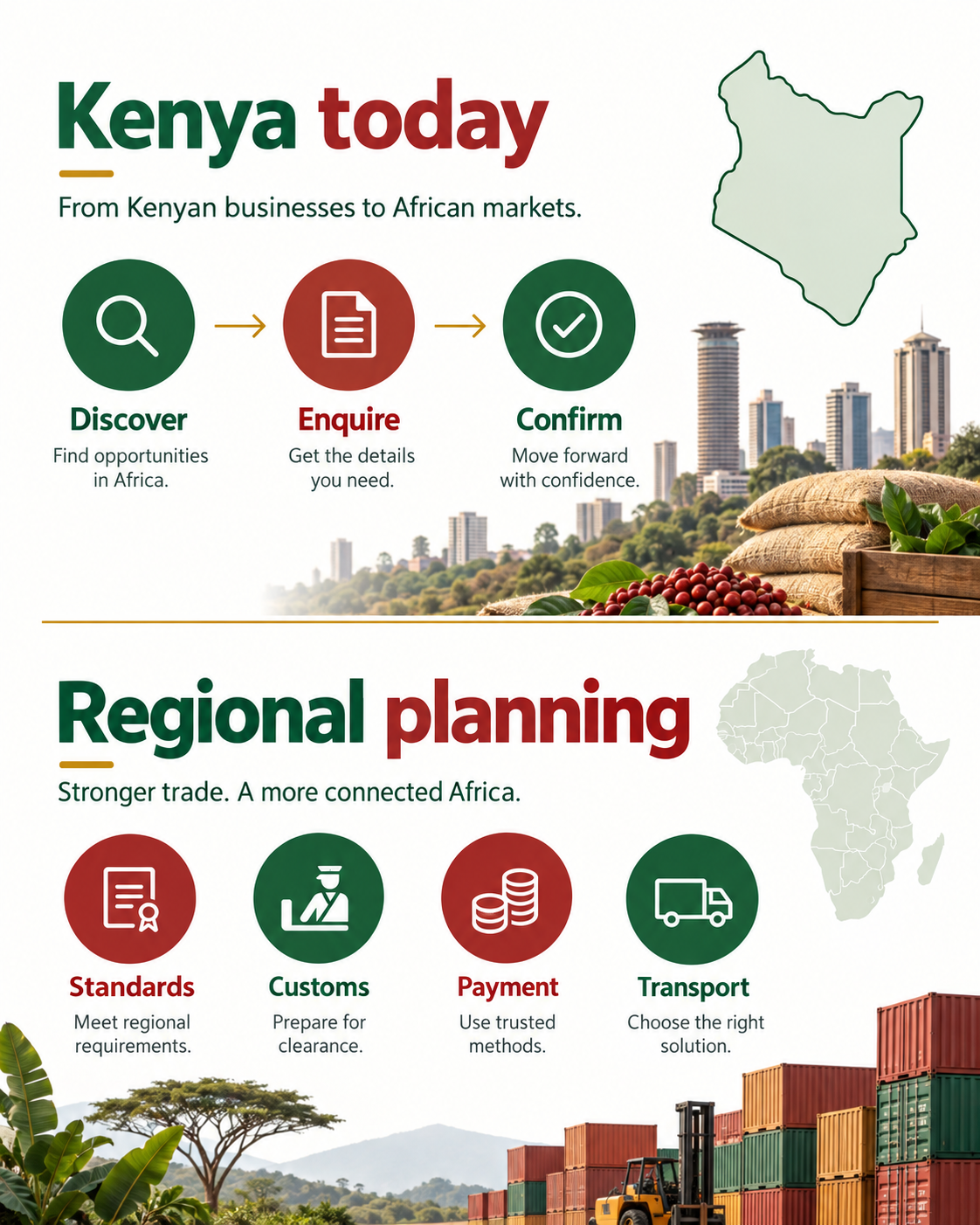
The wider African opportunity is important, but it should be presented honestly. Online visibility can help a Kenyan manufacturer receive interest from buyers beyond Kenya. It does not, by itself, make a product ready for export or make a cross-border transaction simple.
For a business currently buying locally, the immediate benefit is learning a more disciplined sourcing process. Clear specifications, documented quotations and traceable orders are useful foundations for future regional trade. They create habits that become even more important when distance and additional parties enter the transaction.
A future cross-border enquiry needs separate checks on destination-market requirements, customs procedures, applicable taxes, payment arrangements and transport responsibilities. Product labelling or certification accepted in one market may not satisfy another. Confirm requirements with the relevant authorities and qualified service providers before making commitments.
The African Continental Free Trade Area provides a framework for deeper continental trade, but buyers should not assume every shipment receives preferential treatment. Eligibility depends on the applicable rules and implementation arrangements. The official AfCFTA website is a sound starting point for understanding the framework.
Currency also changes the commercial discussion. Agree the quotation currency, payment method and who bears relevant transfer charges. If conversion is involved, clarify how the payable amount will be determined. A familiar product can still become an unfamiliar financial commitment when these details are unresolved.
For Viwanda, keep the present offer distinct from that future context: the marketplace focuses on Kenyan-made products and enquiry-led wholesale. Do not read a product listing as a promise of export capability, regional delivery or customs support. Ask what is actually available for your particular requirement.
10. Start with one well-defined enquiry and measure the improvement
The strongest benefit of B2B ecommerce is not a particular screen or feature. It is the chance to make purchasing more deliberate: discover suitable products, ask better questions, compare complete offers and organise the work that follows. The technology supports the process; it does not replace judgement.
Choose one upcoming purchase as a starting point. It should be important enough to deserve attention but manageable enough for your team to document properly. Write the requirement, shortlist suitable sellers and identify the questions that must be answered before you approve the order.
Then evaluate whether the digital approach improved the work. Did you find relevant options without unnecessary travel? Were quotations easier to compare? Could the receiving team understand what had been ordered? These practical questions are more useful than counting how many messages were exchanged.
Viwanda is currently enquiry-led for wholesale buying. You can explore Kenyan-made products and submit your requirements for clarification and quotation. Online checkout exists only for items stocked by Viwanda; it should not be assumed to apply to every listed product.
Before proceeding, confirm the seller, specification, availability, total payable amount, payment terms and fulfilment arrangement. There is no need to rush an unclear offer simply because the conversation began online. A useful marketplace helps you reach a sound decision, including deciding that an offer is not suitable.
Read how Viwanda works, then send a wholesale enquiry with your product, quantity and destination. Give the supplier enough detail to respond meaningfully. That is a practical first step towards better local sourcing today and stronger purchasing capabilities for tomorrow.
“The value of a digital enquiry is not how quickly it is sent, but how clearly it helps both sides agree on the order.”— Dr. Chomba Chuma, Founder, Viwanda — editorial view
Frequently asked questions
Is B2B ecommerce useful for a small Kenyan shop?
Yes. A small shop can use it to discover Kenyan-made products, send clear enquiries and compare suitable offers. Ask about minimum quantities and supply arrangements before proceeding. The value depends on finding a seller whose products and operating model fit your business, not simply finding the largest catalogue.
Does buying online guarantee a lower wholesale price?
No. Compare equivalent products and complete written offers, including applicable taxes, packaging and transport arrangements. Quantity, specification and payment terms can affect the quotation. Online discovery may make comparison easier, but the supplier must confirm the actual commercial terms for your order.
Can I pay through checkout for every product on Viwanda?
No. Viwanda is currently enquiry-led for wholesale purchases, and online checkout exists only for items stocked by Viwanda. For other listings, submit an enquiry and confirm availability, the quotation, payment terms and fulfilment responsibilities before making a commitment.
Does an online listing prove that a product can be exported?
No. Export readiness needs separate confirmation. Check the seller's ability to supply, destination requirements, customs arrangements, payment terms and transport responsibilities. Viwanda's current focus is Kenyan-made products; African expansion is future context, not a blanket promise that listed goods can be supplied across borders.
Ready to take the next step?
Viwanda makes it straightforward to buy Kenyan-made goods wholesale or reach serious business buyers.
Send your Kenyan-made wholesale enquiry