buyer guide · consumer market
How Much Stock Should a Kenyan Shop Buy? A Daily Cash Flow Guide

Start with one question: how much stock can your shop afford to hold?
How much stock should I buy without running out of cash? For a Kenyan shop owner, this is often more useful than asking which product is popular nationally. Your customers buy from a particular location, at particular prices, in particular pack sizes. A busy estate shop, a market stall and a small supermarket can need very different quantities of the same Kenyan-made product.
The practical answer is to buy enough to cover expected sales until replenishment arrives, plus a sensible allowance for uncertainty. Then check that the order leaves money for rent, wages, transport, taxes and other commitments. Demand tells you what might sell; cash flow tells you what you can safely carry. Both checks must pass before you confirm a wholesale order.
This guide is for businesses buying finished goods for resale, including household products, personal care items and packaged foods. It uses illustrative calculations, not market price claims or promises about supplier performance. Adjust the method for your product's shelf life, storage needs and sales pattern. Fresh goods, made-to-order products and seasonal merchandise need shorter or more specialised planning.
Start with a daily record rather than a complicated system. A notebook or spreadsheet can show what sold, what remains and what needs attention. When you browse Kenyan-made products, use that record to narrow your enquiry instead of building a large order from attractive photographs. The aim is not to own the fullest shelves. It is to keep useful stock moving while protecting the money that keeps your business open.
Read local consumer demand from sales, not assumptions
Start by recording units sold for each product and pack size. Write down the selling price, date and any unusual circumstance, such as a promotion or nearby event. A product name alone is not enough: customers may accept one size but reject another because the amount payable today does not fit their budget. Keep those sales separate.
Look across several ordinary trading periods before calling a product a reliable seller. Payday purchases, school calendars and local trading activity may influence your customers, but do not assume the same pattern applies everywhere. Compare similar days and note exceptions. Ask regular customers what they could not find and whether they bought an alternative, postponed the purchase or went elsewhere.
Sales records also have a blind spot: you cannot sell an item that is missing. If soap sold out on Tuesday and arrived on Friday, the week's sales understate possible demand. Record unavailable days alongside sales, and treat requests for missing goods as clues rather than guaranteed orders. This helps you distinguish weak demand from poor availability.
National information from the Kenya National Bureau of Statistics can provide broader context about consumer prices and economic conditions. It cannot tell you how many cartons your shop will sell next week. Use official statistics to frame questions, then let your own till records, stock counts and customer conversations guide the actual buying decision.
- Record sales by exact item, size and variant, not only by brand.
- Mark days when an item was unavailable or the shop closed.
- Separate normal sales from unusual bulk purchases and promotions.
- Log customer requests, including preferred pack sizes and acceptable substitutes.
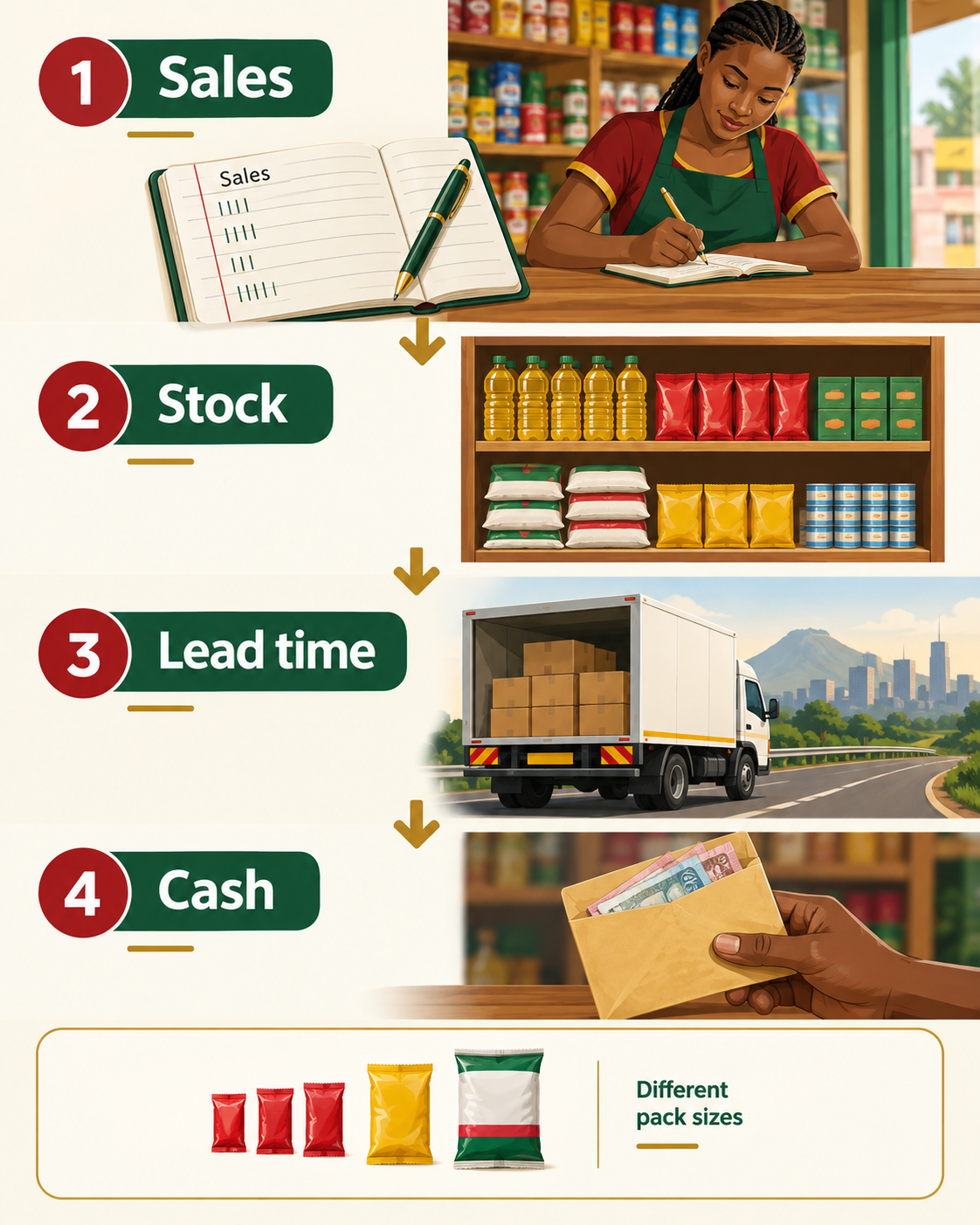
Calculate a reorder point and a realistic order quantity
A reorder point tells you when to act, not necessarily how much to buy. A simple starting formula is average daily sales multiplied by supplier lead time, plus safety stock. Lead time means the period from confirming an order to having saleable goods in your shop. Include processing, dispatch, transport and receiving, rather than relying only on the driving time.
For illustration, suppose an item sells six units per trading day, replenishment takes four trading days and you choose twelve units as a buffer. Your reorder point is thirty-six units: twenty-four for expected lead-time sales, plus twelve for uncertainty. These are example assumptions, not recommended levels for every shop. A short-life product may need a smaller buffer.
Order quantity needs a second calculation. Choose how many days the stock should cover until the next replenishment can arrive. Multiply that coverage by average daily sales, add the buffer, then subtract usable stock and confirmed incoming stock. Make all time periods consistent. Do not mix trading-day sales averages with calendar-day lead times without adjusting them.
- Count usable stock, excluding damaged, expired or otherwise unsaleable units. Identify goods already reserved for customers so they are not treated as freely available.
- Calculate average daily sales from a representative period. Note stockouts and exceptional purchases before deciding whether that average is a sensible forecast.
- Confirm the supplier's current lead time and choose a buffer based on actual uncertainty, storage limits and shelf life.
- Set your target stock level, subtract available and confirmed incoming units, and round carefully to the supplier's pack quantities.
- Check the proposed order against available cash. If it is unaffordable, revise quantities or the ordering schedule before making a commitment.
Compare the full buying cost before setting a shelf price
A low wholesale unit price can become expensive stock once collection, delivery, unloading or other necessary charges are included. Compare suppliers using the cost of getting equivalent, saleable goods onto your shelf. Keep the product specification, pack size and order quantity consistent. Otherwise, you may be comparing a smaller pack or a different grade rather than a genuinely better offer.
For a simple internal calculation, add the costs attributable to a purchase and divide by the number of saleable units received. Allocate shared transport costs consistently across products, using a reasonable basis such as weight, space or value. Tax treatment needs separate attention: whether tax is a recoverable input or part of your cost depends on your circumstances and applicable rules.
Do not confuse markup with gross margin. In an illustration where a product costs KSh 80 and sells for KSh 100, the gross profit is KSh 20. The markup on cost is 25%, while the gross margin on sales is 20%. Neither figure is net profit: rent, wages, losses and other operating expenses still have to be covered.
Before accepting a quotation, check whether the proposed shelf price makes sense for your customers and comparable products nearby. If it does not, avoid assuming volume will rescue the decision. Consider a different pack size, another suitable supplier or a smaller trial. For invoicing and tax obligations, consult current Kenya Revenue Authority guidance rather than relying on a supplier's verbal assurance.
- Ask whether the quotation includes applicable taxes and all agreed charges.
- Confirm units per carton, minimum quantities and any mixed-carton options.
- Clarify collection or delivery arrangements and responsibility for transport damage.
- Check quotation validity, payment terms and the process for reporting shortages.
Protect bill money before allocating the buying budget
Money received today is not automatically available for tomorrow's stock purchase. Some of it replaces the cost of goods already sold, and some must cover upcoming obligations. Before ordering, list payments due before the next realistic cash inflow. Include supplier balances, rent, wages, utilities, taxes and loan repayments where relevant. Keep household withdrawals visible if they come from business cash.
Build a short rolling cash forecast: opening cash, expected receipts, committed payments and proposed purchases. Use money you reasonably expect to collect, not the full value of unpaid customer invoices. A sale on credit may look profitable while leaving you unable to replace the item. Record collection dates and follow up overdue amounts before extending more credit.
Set aside a working reserve for routine surprises, such as an extra collection trip or a slower trading period. There is no universal percentage that suits every Kenyan shop. The right amount depends on how predictable your receipts are, how quickly suppliers can replenish and which bills cannot move. Review the reserve as your business changes rather than treating it as untouchable guesswork.
- Separate committed bill money from money available for purchasing stock.
- Prioritise proven sellers that earn a worthwhile margin and replenish reliably.
- Give unfamiliar products a limited trial budget with a clear review date.
- Avoid borrowing for a larger order without testing repayment against slower sales.
“A full shelf is useful only when it serves customers without emptying the business of working cash.”— Dr. Chomba Chuma, Founder, Viwanda
Check the supplier, product standards and receiving arrangements
A useful supplier check answers three questions: who am I buying from, exactly what will arrive, and what happens if something is wrong? Confirm the business identity, contact details and payment instructions through a dependable channel. Request a clear written quotation and product information. If payment details suddenly change, verify the change independently before transferring money.
For Kenyan-made goods, check the applicable Kenya Bureau of Standards requirements for the product category. KEBS provides information on its certification schemes, including the Standardization Mark for locally manufactured products. Where a permit or mark is required, ask for the relevant details and verify through official channels. A printed logo or marketplace listing alone is not sufficient evidence of compliance.
Inspection should match the product. Packaged food may require attention to ingredients, date marking, storage instructions and packaging integrity. Other goods may have different labelling or safety requirements. Do not assume that every category follows one checklist or that one certification covers every item a manufacturer makes. Consult KEBS and the relevant sector regulator where requirements are unclear.
You can use the manufacturer directory or distributor directory to begin sourcing conversations, then carry out the checks appropriate to your purchase. Ask how shortages, defects and returns are handled before ordering. For unfamiliar goods, inspect a sample where practical, while recognising that a sample does not replace checks on the delivered batch. Agree who will receive the order and which records they will keep, so problems are documented promptly rather than discovered after stock has been mixed together.
Use smaller trials without making replenishment too costly
Buying less can protect cash, but buying tiny quantities too often can increase transport and handling costs. The right order size balances those costs against the risk of unsold stock. Ask suppliers about pack quantities, collection options and whether compatible items can travel together. Do not assume that splitting an order will preserve the same price or terms.
For a new product, define the trial before it arrives. Decide where it will be displayed, the intended selling price and when you will review sales. Specify what would justify a repeat order: consistent purchases, acceptable margin and manageable customer complaints are stronger evidence than initial curiosity. Avoid adding several similar variants at once if that makes the results difficult to interpret.
Shelf life limits how much apparent value a bulk offer can provide. Check the usable selling period remaining when goods reach your shop, not just the date they leave the factory. Allow time for normal sales and reasonable customer use. For dated products, rotate stock so the earliest expiry is sold first, provided the goods remain safe and suitable for sale.
If a supplier's minimum order is too large, ask about a suitable distributor or a different pack arrangement. A shared purchase with another business needs clear agreement on payment, ownership, collection and dispute handling. It is not automatically safer simply because the carton price is lower. Choose an arrangement you can manage and document, and reject quantities that depend on unusually strong sales to work.
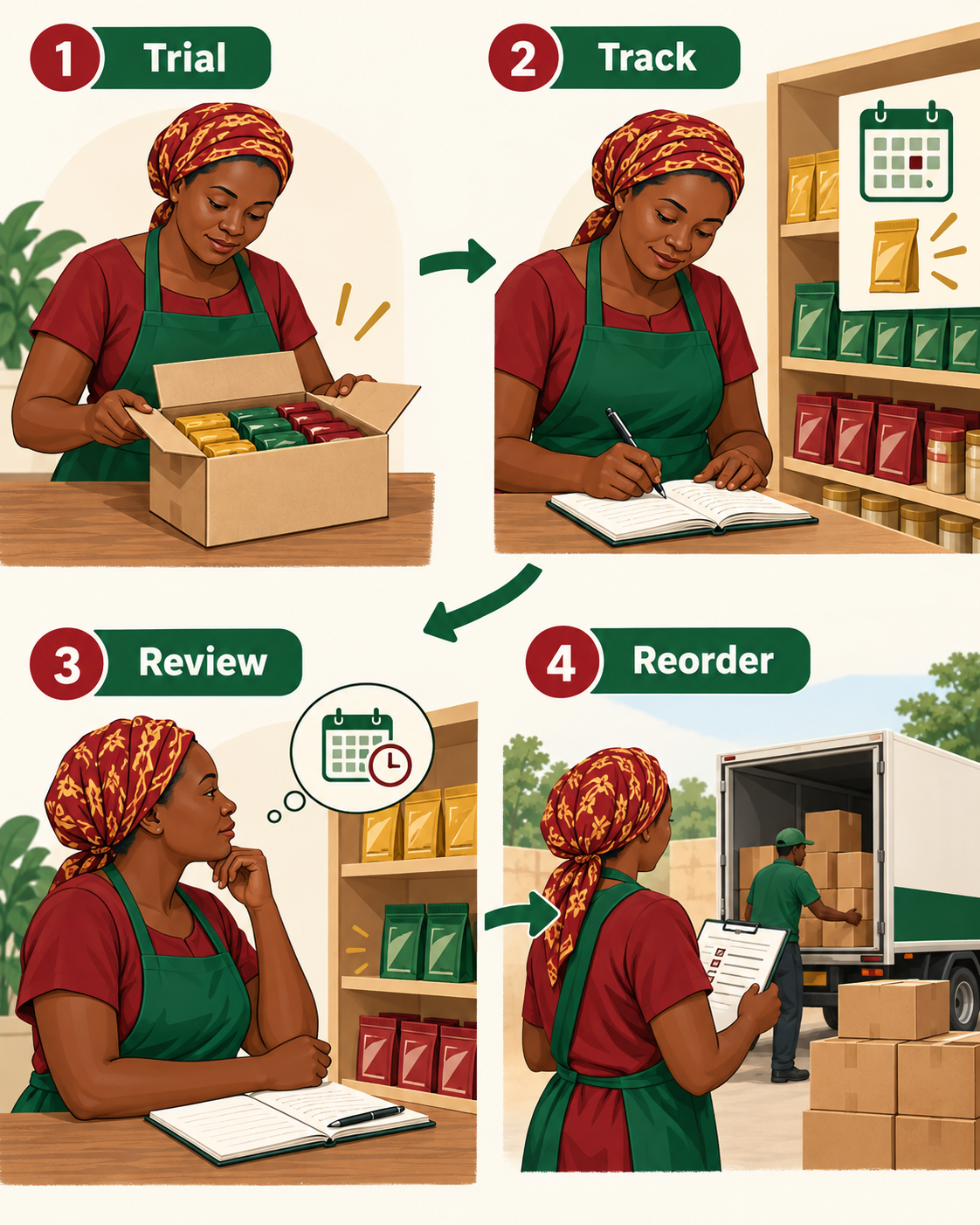
Run a short daily stock check and a deeper weekly review
Each trading day, check the products whose absence would disappoint regular customers or interrupt a valuable basket of purchases. Compare their available stock with the reorder points you set. Confirm whether incoming orders are still on track. A quick count of important lines can reveal a problem early without requiring a full shop stocktake every evening.
When goods arrive, match them against the agreed order and delivery documents. Count cartons and, where practical, confirm their contents. Inspect condition, variants and relevant dates before shelving. Record shortages or damage clearly and report them through the agreed process. Update the stock record only for quantities actually received, with unsaleable goods identified separately.
Once a week, review slow-moving stock and repeated stockouts together. Both can indicate a buying plan that no longer matches demand. Investigate before changing quantities: a product may be poorly displayed, incorrectly priced or repeatedly unavailable. Check for recording errors, breakages and unexplained losses too. Buying more cannot solve a stock record that is consistently wrong.
Finish the review with a short action list: reorder, hold, investigate or stop buying. Reduce future orders for weak lines before considering lawful, appropriate ways to clear remaining stock. Recalculate your important assumptions when sales patterns or supplier lead times change. Keep notes about why you made each adjustment so the next review builds on evidence rather than memory. Over time, this routine becomes your own local consumer-market guide, grounded in the customers who actually enter your shop.
Send a wholesale enquiry that suppliers can answer clearly
A good enquiry turns your stock plan into a specific purchasing conversation. State the product, size or specification, estimated quantity and receiving location. Explain whether this is a first trial or a repeat purchase. If the quantity depends on carton size or minimum order requirements, say so. Clear details help a supplier respond without unnecessary rounds of clarification.
Ask for a written quotation covering availability, pack quantities, applicable taxes, transport arrangements, payment terms and expected lead time. Request relevant compliance information and the procedure for shortages or defects. If timing matters, state your required arrival date as a request, not an assumption. Confirm what the supplier can actually commit to before arranging payment or advertising availability to customers.
Viwanda is currently an enquiry-led wholesale marketplace for Kenyan-made products only. Online checkout is available only for items stocked by Viwanda; it is not a universal checkout for every listed product. You can see how Viwanda works before starting your sourcing enquiry. Prices, order terms and delivery arrangements need confirmation for the particular goods and transaction.
Before sending your next enquiry, write down three numbers: the stock you can use, the quantity your demand estimate supports and the cash you can safely spend. If they disagree, revise the order rather than hoping sales will catch up. Then send a wholesale enquiry with your product requirements and location. A disciplined buying decision starts with clear information, leaves room for verification and protects your ability to serve customers again tomorrow.
Frequently asked questions
How much stock should a small Kenyan shop buy at first?
There is no reliable amount that fits every shop. Begin with a focused range, manageable trial quantities and a separate reserve for operating expenses. Use early sales records to adjust quantities. Avoid spending the entire opening budget on stock before testing which products, sizes and prices your customers accept.
How often should I reorder wholesale goods?
Reorder when available stock reaches the level needed to cover confirmed replenishment time plus your chosen buffer. Review important items daily, but do not assume every product needs a daily order. Consolidate purchases where practical, provided the savings do not create stockouts, excessive holding costs or expiry risk.
Is the lowest wholesale price always the best choice?
No. Compare equivalent goods using total buying cost, quality, saleable quantity, payment terms and replenishment reliability. A cheaper carton may require too much cash or contain a pack size customers rarely buy. Judge the purchase by its likely contribution to the business, not the headline unit price alone.
Can I buy every product on Viwanda through online checkout?
No. Viwanda is currently enquiry-led for wholesale sourcing of Kenyan-made products. Online checkout is available only for items stocked by Viwanda. For other sourcing needs, submit an enquiry and confirm availability, quantities, pricing, payment terms and logistics before committing. Do not assume a listing guarantees immediate stock or delivery.
Ready to take the next step?
Viwanda makes it straightforward to buy Kenyan-made goods wholesale or reach serious business buyers.
Send your stock list for a wholesale enquiry