seller guide · distribution
Distribution in Kenya: How to Set a Wholesale Delivery Price Without Losing Money

1. Should your wholesale price include delivery?
A shopkeeper asks for your best wholesale price, then adds one more question: does that include delivery? For a Kenyan manufacturer or distributor, that small question can decide whether an otherwise useful order makes money. A product margin is not the same as the money left after fulfilling the order.
The practical answer is to include delivery only when the order can carry its share of fulfilment costs. Otherwise, charge separately or offer collection. There is no single delivery pricing method that suits every product, town or buyer. A carton of light garments and a load of bulky furniture place different demands on transport.
This guide answers one specific question: how should a business distributing Kenyan-made products set a wholesale delivery price without quietly absorbing a loss? The approach works whether you use your own vehicle, hire a transporter or consolidate several customers into one trip. Start with the delivery promise, then work backwards to the cost.
On Viwanda, you can browse Kenyan-made products and enquire about supply arrangements. Viwanda is currently enquiry-led wholesale; online checkout is available only for items stocked by Viwanda. For other supply enquiries, confirm the quotation and delivery terms before committing. Treat the product price and the delivery agreement as connected but distinct decisions. That separation gives both sides room to choose collection, a shared route or a dedicated trip without confusing the underlying value of the goods. It also makes later price comparisons much fairer.
2. Define exactly what the delivery price covers
Before calculating a charge, describe the service. Delivery to a buyer's gate is different from unloading into a storeroom upstairs. Delivery to an agreed collection point is different from visiting several branches. If the quotation leaves these differences open, the driver often discovers the real job only after arriving.
Ask for a usable location, a receiving contact and any access restrictions. Establish whether the premises can receive your vehicle, whether someone will help unload and whether there are agreed receiving hours. These are not small administrative details. They affect vehicle choice, time at the stop and the possibility of a failed delivery.
Use a short delivery description that a buyer can read on a phone. It should explain the destination, handover point and responsibilities without hiding conditions in complicated language. Where special handling is needed, agree it before dispatch rather than presenting an unexpected charge when the goods arrive.
For example, a furniture distributor might quote transport to an accessible ground-floor receiving point, with assembly priced separately. A packaged food distributor might include unloading cartons but exclude distribution between the buyer's branches. Neither arrangement is automatically better. The important point is that the buyer knows what is being purchased and your costing matches that promise.
- Name the destination and the exact handover point.
- State who loads, unloads and provides handling equipment.
- Agree receiving hours and treatment of avoidable waiting.
- Explain what happens if the buyer cannot receive the order.
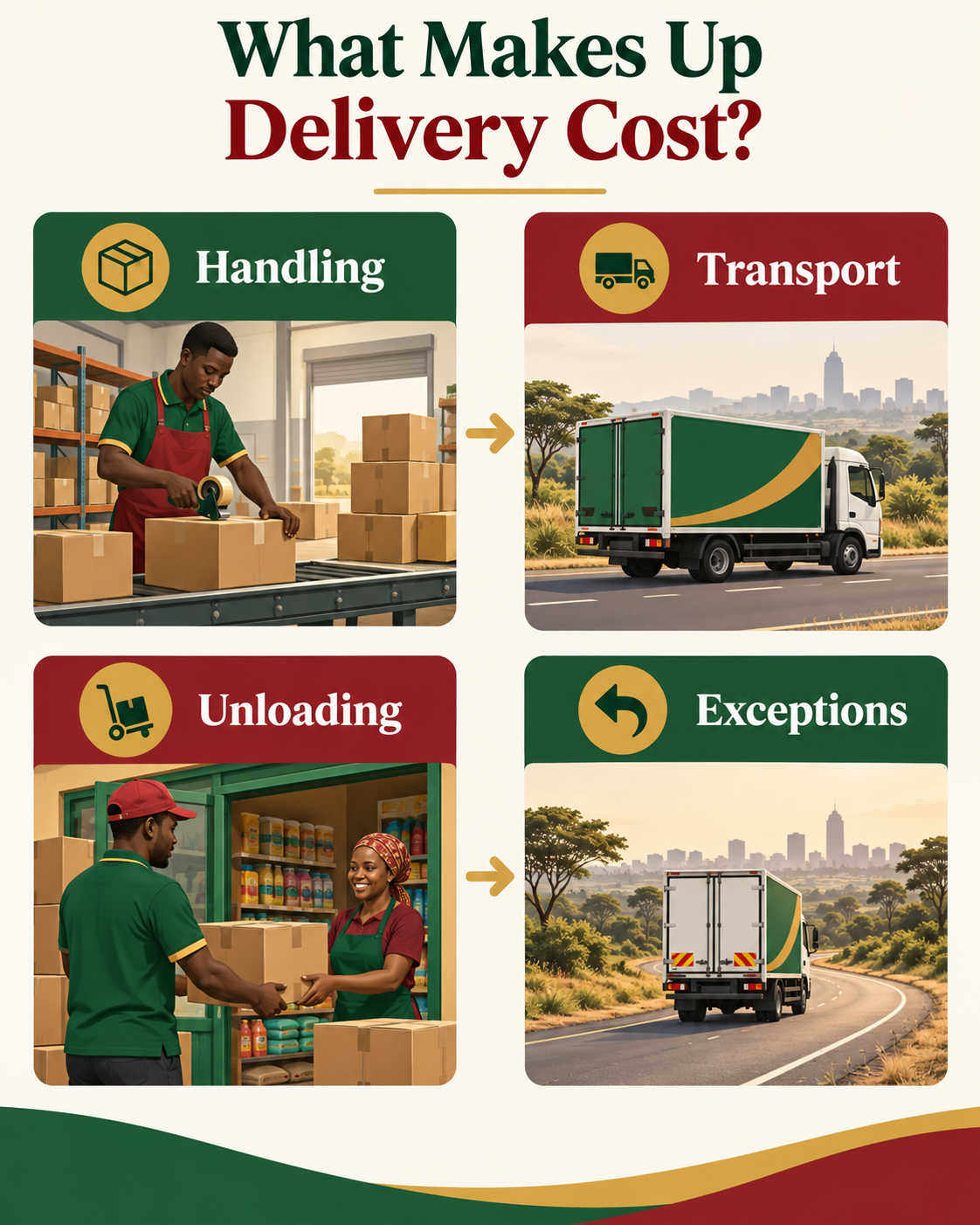
3. Calculate the full cost, not just the fuel
Fuel is visible, so it often becomes the entire delivery calculation. But fulfilment starts before the vehicle moves. Someone picks the order, checks quantities, packs vulnerable items and prepares documents. After delivery, someone may reconcile payment, resolve shortages or collect returnable packaging. These activities use time and resources even when no separate invoice arrives.
For your own vehicle, consider the trip's fuel and labour alongside a reasonable allocation for maintenance, insurance and ownership costs. For hired transport, start with the written quote and identify exclusions. Do not count the same expense twice. If the transporter includes a driver and fuel, those amounts should not reappear as separate transport costs.
Separate costs that belong to a particular order from costs shared across the route. Special packaging belongs to the order needing it. The main journey may serve several buyers. Your allocation does not need to be elaborate, but it should reflect how each order uses capacity and time. Record the method so another staff member can repeat it.
Keep tax treatment clear as well. Record whether quoted costs include applicable taxes and seek accounting advice on recoverable taxes. Use the Kenya Revenue Authority's official guidance for current invoicing and tax requirements rather than assuming every business has the same obligations.
- Handling: picking, checking, packaging and loading.
- Transport: vehicle costs, driver time and hired carriage.
- Destination: unloading, access charges and agreed waiting.
- Exceptions: failed trips, damage handling and reverse transport.
4. Share route costs fairly between orders
When one vehicle serves several shops, dividing the journey cost equally can look fair while producing poor decisions. One buyer may take most of the vehicle's space. Another may order little but require a long detour. A third may be easy to serve because its premises sit directly on the route.
A useful starting point is a shared journey allocation plus a stop-related cost. Allocate the shared journey according to the main constraint: weight, volume or another relevant capacity measure. Then account for extra distance, unloading time or special access at each stop. Avoid using sales value alone when expensive small goods and cheap bulky goods travel together.
Imagine a route carrying mattresses and small packaged household items. Dividing costs only by invoice value could undercharge the mattresses for the space they occupy. Conversely, charging solely by weight could make a light but bulky load appear almost free to move. Use the measure that best explains why the vehicle becomes full or the working day becomes long.
Do not build a complex spreadsheet before you have dependable observations. Start with a simple route sheet showing orders, load size, kilometres and time at each stop. Compare the allocation with what actually happened. If one stop repeatedly creates extra work, address that delivery arrangement directly instead of spreading its cost invisibly across every customer. A clear method also helps your sales team explain why two orders going to the same town may receive different delivery quotes.
5. Use a worked example to check the margin
The following figures are invented for illustration, not market rates. Suppose an order brings in KSh 30,000 in sales and the goods cost the seller KSh 24,000. That leaves KSh 6,000 before fulfilment and other business expenses. For simplicity, all amounts use the same tax basis; actual quotations must handle applicable taxes correctly.
Now suppose picking and packaging cost KSh 500, the order's allocated transport cost is KSh 2,000, and unloading costs KSh 500. Total fulfilment cost is KSh 3,000. If the seller includes delivery within the KSh 30,000 price, KSh 3,000 remains after these costs. That balance still has to contribute towards overheads and profit.
If the seller instead charges KSh 3,000 separately for delivery, the combined receipts become KSh 33,000. After the goods and stated fulfilment costs, KSh 6,000 remains. This does not prove the customer will accept the price. It shows what each offer means financially, allowing the seller to negotiate with a clear starting point.
Also distinguish margin from markup. The KSh 6,000 difference between KSh 30,000 sales and KSh 24,000 goods cost is a 20% gross margin on sales, but a 25% markup on cost. Confusing those measures can distort pricing before transport even enters the discussion. Use one consistent worksheet: sales plus delivery income, less goods cost, less fulfilment cost, equals contribution before remaining overheads. When the result looks weak, change the order size, delivery arrangement or price instead of assuming more sales will automatically solve it.
6. Choose a delivery rule your sales team can apply
A good delivery rule balances accuracy with ease of use. If every enquiry needs a fresh management meeting, quotations become slow and inconsistent. If the rule is too broad, difficult orders can consume the earnings from easier ones. Aim for a standard approach with clearly identified exceptions.
Buyer collection works where customers can arrange suitable transport and you can manage a safe handover. A separate delivery charge makes transport visible and allows location-specific costing. Delivery included in the product price can simplify buying, but only if you define the area, order conditions and service covered. Calling it free does not remove its cost.
Zone pricing can help when you serve repeat destinations, but draw zones from actual operating conditions rather than county boundaries alone. Access, route density and unloading requirements matter. A nearby customer can be expensive to serve if the vehicle waits for hours, while a farther customer may fit neatly into a well-filled route.
When speaking with distribution businesses, compare the whole offer rather than the headline charge. Ask how each arrangement handles collection, shared trips and unusual loads. Select the rule you can explain, record and review. Keep exceptions subject to approval so a hurried salesperson does not accidentally promise an uneconomic service.
- Collection price: buyer arranges agreed onward transport.
- Separate delivery: product and transport charges appear distinctly.
- Conditional inclusion: delivery applies within stated order and service limits.
- Route-day offer: eligible buyers share a scheduled distribution trip.
7. Set minimum orders around contribution, not guesswork
A minimum order for included delivery should come from the contribution available to pay for that delivery. Copying a competitor's threshold is risky because your product mix, buying terms and routes may differ. A threshold that works for compact, higher-margin goods may fail for bulky goods with little room between cost and selling price.
Use a simplified calculation as a starting point: delivery cost divided by the contribution rate available before delivery. In an invented example, a KSh 1,500 delivery cost and a 15% contribution rate produce a KSh 10,000 order value just to cover delivery. That is a delivery break-even threshold, not a healthy profit target.
The rate must already reflect relevant costs other than delivery, or the result will be too optimistic. You also need room for overheads, profit and reasonable uncertainty. Where an order contains products with different margins, use its actual mix rather than assuming every shilling of sales contributes equally. Recalculate when that mix changes materially.
Offer alternatives when an order falls below the threshold. The buyer might collect, pay the delivery charge or wait for a shared route, provided the timing suits both sides. Do not pressure a small shop into unnecessary stock merely to meet your transport rule. You can review product options with Kenyan manufacturers, but the aim is a workable order, not a larger invoice at any cost. A sustainable arrangement should protect the seller's contribution while giving the buyer a sensible landed cost.
8. Put the price and handover terms into a repeatable process
Once the costing method is clear, turn it into a short quotation routine. This reduces the gap between what sales promises and what dispatch can provide. One person should be able to trace the buyer's request through the quote, loading record and proof of delivery without relying on someone's memory.
Written terms do not need to sound unfriendly. Explain what is included, what needs separate approval and how changes will be handled. Give the buyer a chance to correct the location or receiving arrangements before the vehicle is booked. Keep agreed amendments with the order record.
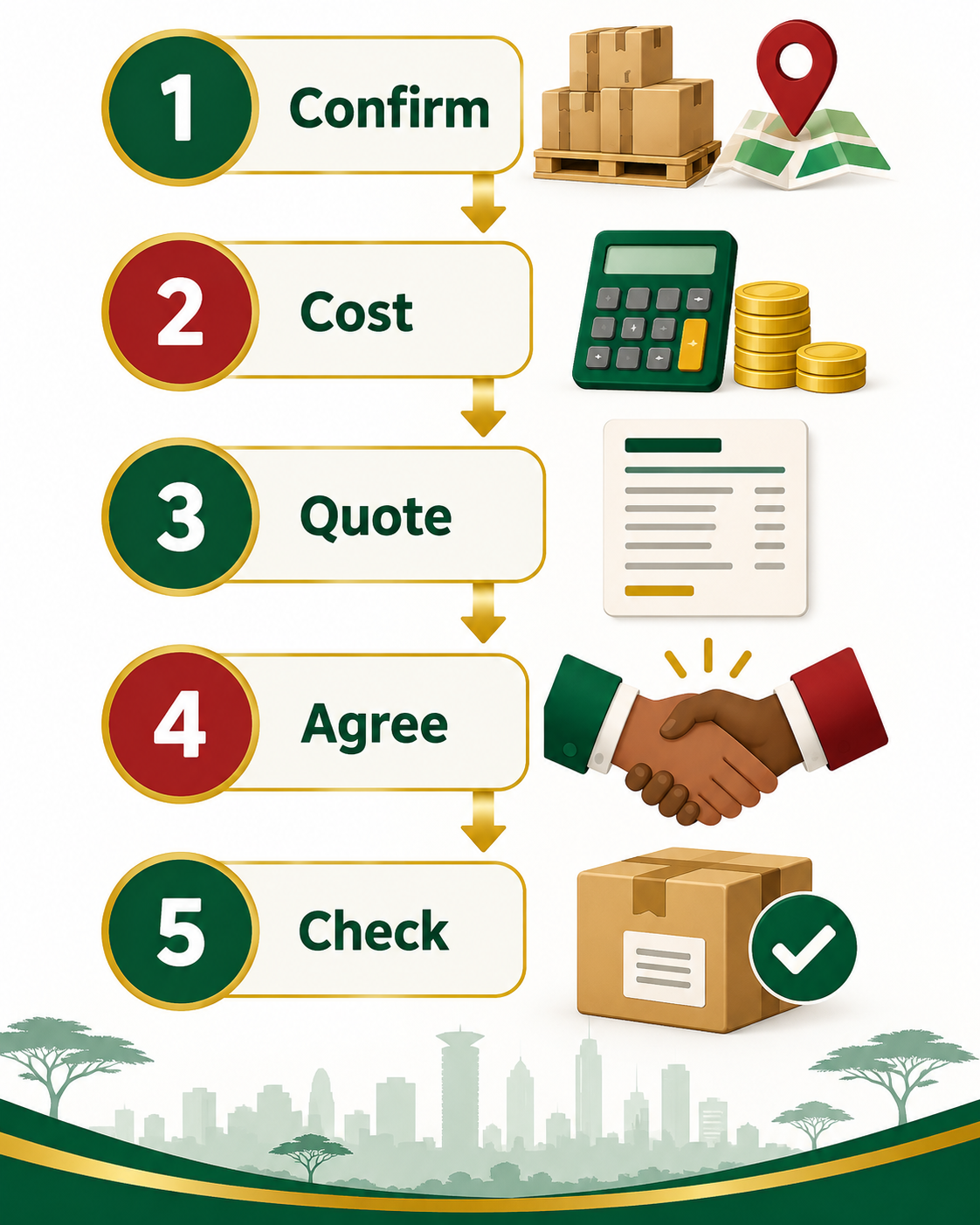
Use the following sequence for each new destination or unusual order. Repeat buyers may need fewer questions, but do not assume their receiving contact, access conditions or unloading arrangements remain unchanged forever. For applicable invoicing requirements, consult KRA guidance; a delivery note should not be treated as a substitute for a required invoice.
- Confirm the goods, quantities, destination and receiving contact. Ask about vehicle access, unloading needs and any product-specific handling requirements before calculating the transport charge.
- Cost the order using the expected route and load. Separate order-specific expenses from shared journey costs, and check what any hired transporter actually includes.
- Issue a written quotation showing product charges, delivery charges or inclusion conditions, applicable tax treatment, payment terms and how long the quotation remains valid.
- Obtain agreement before dispatch. Record responsibility for loading, unloading, loss or damage, and any extra charges that require approval if circumstances change.
- Check goods at handover, record shortages or visible damage, obtain delivery confirmation and compare actual fulfilment costs with the original estimate.
9. Agree returns and failed deliveries before they happen
A delivery price is incomplete if nobody knows what happens when the trip goes wrong. The buyer may be closed, the location may be incorrect or the goods may arrive damaged. Each situation has a different cause, and charging every problem to the same party can create unnecessary disputes.
Separate seller errors, transport incidents and buyer-requested changes. Wrong goods dispatched by the seller should not be treated like a buyer changing their mind after receiving the correct order. Agree a fair investigation and resolution process, consistent with applicable law and the contract, rather than improvising blame while the driver waits.
For failed deliveries, record the agreed location, contact attempts and reason the handover did not happen. Establish how redelivery will be authorised and priced. If your quote includes a waiting allowance, explain when it starts and how additional waiting is approved. Avoid surprise deductions or charges unsupported by the agreed terms.
Returns also need practical handling rules. Identify who approves them, where goods go and what evidence supports a shortage or damage report. Food, cosmetics and other sensitive goods may require additional care; check relevant product standards and handling requirements with KEBS and other responsible authorities. Never return questionable goods to sale merely because they look acceptable from outside. Where reusable crates or containers are involved, record their movement separately from product quantities. Clear records protect relationships because both parties can discuss the same facts instead of reconstructing events from scattered messages several days later.
10. Review real routes and improve the next quotation
Your first delivery rule is a working estimate, not a permanent truth. Review completed trips regularly and after a meaningful operating change. Compare estimated and actual transport costs, time at stops, vehicle utilisation and contribution after fulfilment. A busy route is not necessarily a profitable route if too much time or capacity produces too little contribution.
Look for patterns before raising every customer's charge. Repeated waiting may call for better receiving appointments. Small scattered orders may suit shared route days. Frequent damage may point to packaging or loading problems. Pricing can recover legitimate costs, but it should not become a substitute for fixing avoidable waste in the operation.
Tell repeat buyers about revised terms before applying them to new orders, and honour existing agreements unless both parties agree otherwise. Explain the service options, not just the increase. A buyer who cannot accept a dedicated trip may still accept collection or a consolidated delivery. Predictability helps the customer plan their own selling price.
Make your next enquiry specific: list the Kenyan-made products, quantities, destination and preferred receiving arrangement. Learn how Viwanda works, then send a wholesale enquiry to begin the conversation. Ask for a clear quotation rather than assuming a listed product includes transport. The goal is a delivery arrangement that both sides understand and that your business can repeat without quietly losing money.
“A delivery promise should be easy for the buyer to understand and possible for the seller to sustain.”— Dr. Chomba Chuma, Founder, Viwanda
Frequently asked questions
Is there a standard wholesale delivery charge in Kenya?
There is no single charge suitable for every wholesale order. Ask for a quotation based on the goods, load size, destination, access and handling requirements. Compare what each offer includes, not just its headline amount, and confirm whether applicable taxes are included.
Should I offer free delivery above a minimum order?
Only if the order's contribution can cover fulfilment costs while leaving enough for overheads and profit. State the eligible area, product conditions and delivery service. Test the threshold against actual orders, especially where bulky or lower-margin goods form a large share of sales.
Who should pay when a wholesale delivery fails?
Responsibility should follow the agreed terms, the cause of failure and applicable law. Record what happened before deciding on redelivery charges. Seller errors, transporter problems and a buyer being unavailable are different situations; avoid a blanket rule that ignores those differences.
Can I pay online for every product listed on Viwanda?
No. Viwanda is currently enquiry-led wholesale for Kenyan-made products, with online checkout only for items stocked by Viwanda. For other products, submit an enquiry and confirm availability, pricing, payment and delivery arrangements through the quotation process before making a commitment.
Ready to take the next step?
Viwanda makes it straightforward to buy Kenyan-made goods wholesale or reach serious business buyers.
Send your wholesale and delivery enquiry