buyer guide · consumer market
Small or Large Packs? How Kenyan Shops Can Match Pack Sizes to Customer Budgets

Start with the customer's spending decision, not the supplier's carton
Should your shop stock smaller packs that customers can pay for easily, or larger packs that may offer better value? For Kenyan retailers buying products such as flour, soap, cooking oil or household cleaners, this is a practical consumer market question. The answer affects your selling price, the space each product occupies, and whether customers can find something that fits the money they have available.
Start by separating affordability from value. Affordability means the amount a customer must pay now. Value means what that payment buys, considering quantity, quality and usefulness. A shopper may understand that a larger pack costs less per kilogram but still choose the smaller one because other purchases must fit into the same budget. That is a rational spending decision, not necessarily a misunderstanding.
There is no single pack size that suits the whole Kenyan consumer market. A shop near student accommodation may serve different needs from one supplying households doing planned shopping. Even within one neighbourhood, customers can buy small packs for immediate needs and larger ones for regular use. Your task is to identify those buying occasions rather than assume that every customer wants the cheapest sticker price.
This guide focuses on choosing manufacturer-packed Kenyan-made products for resale, not repacking goods yourself. Begin with what customers ask for, compare the economics, and test a manageable range. You can browse Kenyan-made products to identify possible options, but treat an attractive listing as the beginning of an enquiry. Confirm available sizes, quantities and commercial terms before deciding what belongs on your shelf.
Find out which buying occasions your customers need you to serve
For a normal trading period, ask staff to record requests that reveal why a particular size matters. Write down the product, the requested size, and whether the customer bought an alternative or left without buying. Keep observations anonymous. You need buying patterns, not names, phone numbers or assumptions about someone's income. A simple notebook beside the till can be enough.
Ask neutral questions when the opportunity arises. Instead of saying, 'Would you prefer a cheaper pack?', ask, 'Which size were you looking for?' or 'Is this for regular use or a particular job?' The wording matters because leading questions can produce answers that support your existing opinion. Do not hold up a queue or pressure customers to explain personal financial circumstances.
Use the following buying occasions as starting points, then check them against your own records. They are possibilities to investigate, not claims about every Kenyan shopper. One customer can appear in several groups during the same month.
- Immediate use: the customer needs enough for today's meal, cleaning task or other short-term requirement.
- Routine replenishment: the household replaces a familiar product and wants a predictable size and purchase amount.
- Planned bulk use: a larger household or business expects to consume enough to justify a bigger pack.
- Trial purchase: the customer wants to test an unfamiliar Kenyan-made product before committing more money.
Compare the shelf price with the price per usable unit
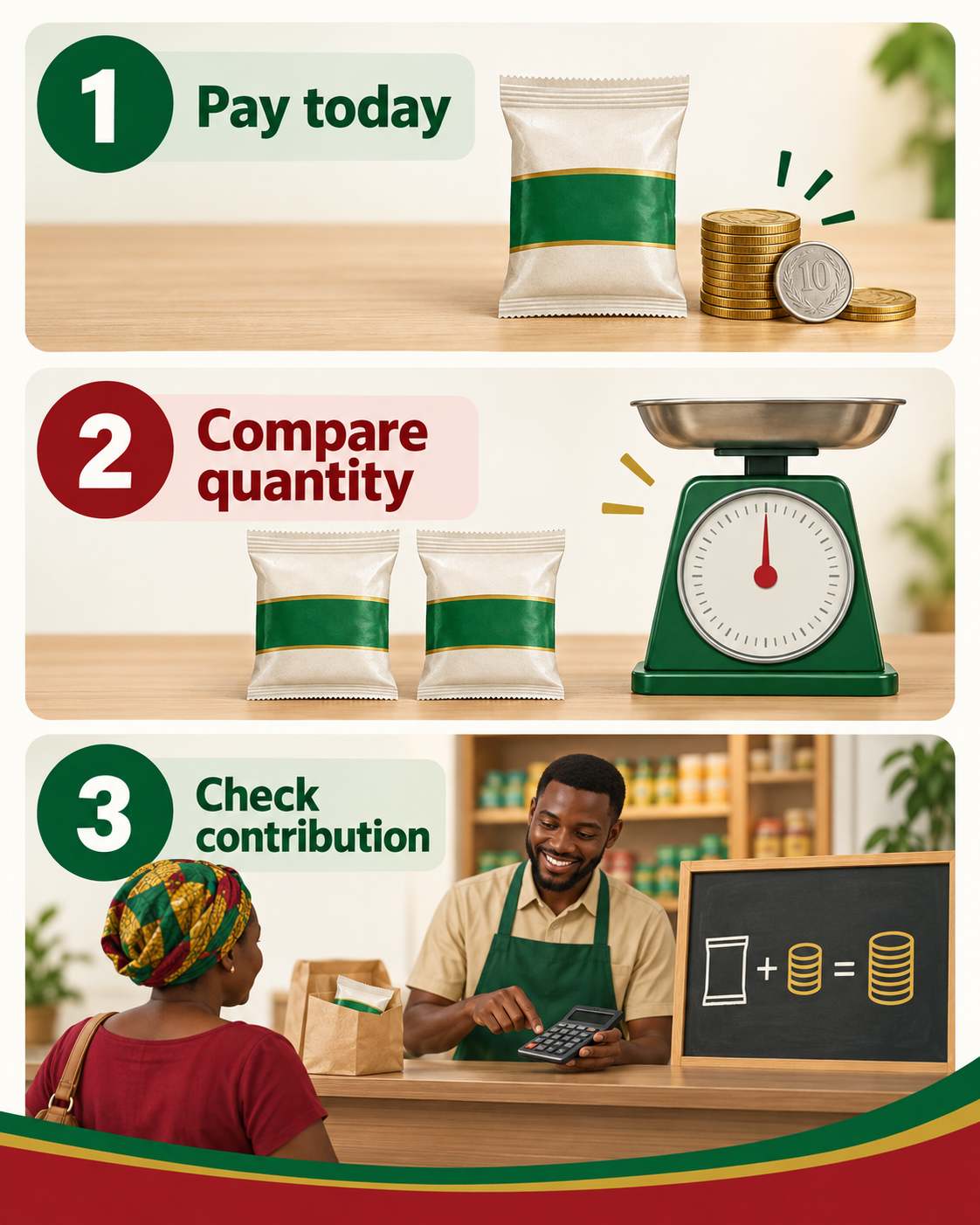
The shelf price tells customers what they must pay. The unit price helps you compare quantities fairly. For comparable products, divide the selling price by the stated net quantity, using the same measurement throughout. Compare kilograms with kilograms, litres with litres, or equivalent counts with equivalent counts. Do not compare the outside dimensions of containers; packaging can make similar quantities look very different.
Consider a purely illustrative example, not a market quotation. A 500 g pack selling for KSh 80 costs KSh 160 per kilogram. A 1 kg pack selling for KSh 150 costs KSh 150 per kilogram. The larger pack offers a lower price per kilogram, but the smaller pack requires less money at the till. Both can serve a legitimate customer need in the same shop.
Quantity alone does not settle every comparison. A concentrated cleaner may have different dilution instructions from a ready-to-use product. Different materials, grades or intended uses can also make a direct comparison misleading. Follow the manufacturer's stated instructions rather than inventing an equivalent quantity or assuming that all products with similar names perform alike. Where equivalence is unclear, explain the difference instead of presenting a false saving.
Display the pack size clearly alongside your selling price. If you choose to add unit prices, keep the calculation consistent and update it whenever either quantity or price changes. A shelf label left behind after a product change can confuse buyers even when nobody intended to mislead. Clear comparisons help customers choose according to both their immediate budget and their expected use.
Check what each size contributes, not just its percentage margin
A pack that customers like must also make commercial sense for your shop. Calculate its direct contribution using the selling price less the purchase cost and other variable costs attributable to that sale. Allocate inbound transport sensibly across the goods received. Include relevant handling or transaction costs where they apply, and avoid counting the same cost twice. Treat taxes consistently with your business's circumstances.
Here is another hypothetical example. If a small pack sells for KSh 50 and its allocated variable cost is KSh 42, it contributes KSh 8 before fixed overheads. If a larger pack sells for KSh 140 and its allocated variable cost is KSh 115, it contributes KSh 25. Neither figure alone tells you which pack deserves more shelf space; actual sales volumes still matter.
Percentage margin and shillings earned answer different questions. So do contribution per sale and contribution over a trading period. A small pack may produce frequent purchases, while a large pack produces fewer but higher-value sales. Record both rather than choosing the pack with the most impressive-looking percentage. Also notice whether one size creates extra counting, shelving or customer explanation work.
Compare the whole product line before and during your test. If customers simply move from one size to another, sales of the new pack may look encouraging without improving total contribution. Conversely, a smaller pack may capture purchases that previously went elsewhere. Your records should help distinguish genuine additional demand from switching between sizes already on your shelf. Do not describe contribution as final profit: rent, wages and other overheads still need to be covered.
Ask suppliers questions that reveal the real pack-size options
A manufacturer's product range and the range available for your particular order may differ. Before planning shelf labels or making customer promises, confirm the exact pack sizes currently offered. Ask whether the quotation refers to individual packs, inner bundles or complete cartons. An unclear carton description can distort both your cost comparison and your understanding of how much stock you are committing to buy.
You can explore Kenyan manufacturers or find distributors as part of your sourcing process. Frame your enquiry around the customer need you have observed. Saying that buyers request a lower purchase amount gives a supplier more useful context than simply asking for their cheapest product. Still, let the supplier confirm what is available; do not assume a different size can be produced for your order.
Use a written checklist so that competing responses are comparable. A lower quoted pack price is not enough if the pack contains a different quantity or requires an unsuitable order size. Keep the final confirmation with your purchasing records, especially when terms were first discussed over the phone.
- Pack definition: request the product name, net quantity, packaging format and number of retail packs per carton.
- Order flexibility: ask about minimum quantities and whether different sizes can be combined in one order.
- Price basis: confirm the quotation's validity, tax treatment, transport arrangements and any other charges that apply.
- Product information: request relevant storage instructions, shelf-life information and applicable compliance details before committing.
- Supply continuity: ask how repeat enquiries and unavailable sizes are handled, without assuming future availability or fixed lead times.
Keep smaller packs convenient without weakening product information
Choosing a lower purchase amount should not mean accepting unclear product identity, missing quantity information or unsuitable packaging. For each size, check the information and certification requirements that apply to that product category. KEBS is the official starting point for Kenyan standards and certification guidance. Requirements differ, so avoid treating one mark or one label checklist as sufficient for every kind of product.
Pay particular attention when a supplier suggests splitting a larger sales unit. Opening an outer carton containing individually labelled retail packs is different from pouring, cutting or dividing a product into new retail packages. The second activity can introduce labelling, hygiene, measurement and other obligations. This guide does not recommend informal repacking as a shortcut to an affordable price point.
If you are considering repacking or private labelling, get category-specific guidance before proceeding. Confirm who is responsible for the product, the packaging and the required information. For ordinary retail buying, manufacturer-packed options can simplify the discussion, but they still need checking. Do not assume that a familiar brand name means every offered pack format is authorised or suitable for individual sale.
During selection, look at how customers will actually use the pack. Can the contents be stored appropriately after opening? Are the instructions readable? Does the pack clearly identify its quantity? A larger pack that is difficult to store or finish may not deliver practical value to that buyer, even when its unit price is lower. Avoid promising savings that depend on conditions you have not considered.
“A useful pack size fits the customer's task, budget and ability to use the product well.”— Dr. Chomba Chuma, Founder, Viwanda — editorial view
Run a controlled shelf test before expanding the range
You do not need an elaborate research exercise to improve a pack-size decision. You need a test that changes as little as possible apart from the choice being examined. Start with one product line where requests suggest an unmet need. Testing many brands, sizes and prices together makes it difficult to understand what customers are responding to.
Choose a test period that includes the buying occasions relevant to your shop, rather than judging results from one unusually busy afternoon. Note interruptions such as stockouts, a promotion or a nearby event. Keep the selected packs visible and correctly priced. A product hidden behind other goods has not received a fair test of customer demand.
The following process turns informal observations into a decision you can explain to your staff and supplier. Keep the records short enough to maintain during normal trading. Consistent simple information is more useful than a detailed spreadsheet that nobody updates.
- Define the question: write down which unmet need the new size should serve, such as a lower amount payable today.
- Record the starting point: note current pack sales, selling prices, contribution estimates and requests you cannot satisfy.
- Confirm a limited purchase: obtain written pack details and terms, then choose a commitment your business can manage.
- Keep presentation comparable: show accurate quantities and prices, and avoid changing several other selling conditions at once.
- Log outcomes: track units sold, customer requests, unavailable stock and switches between the sizes you offer.
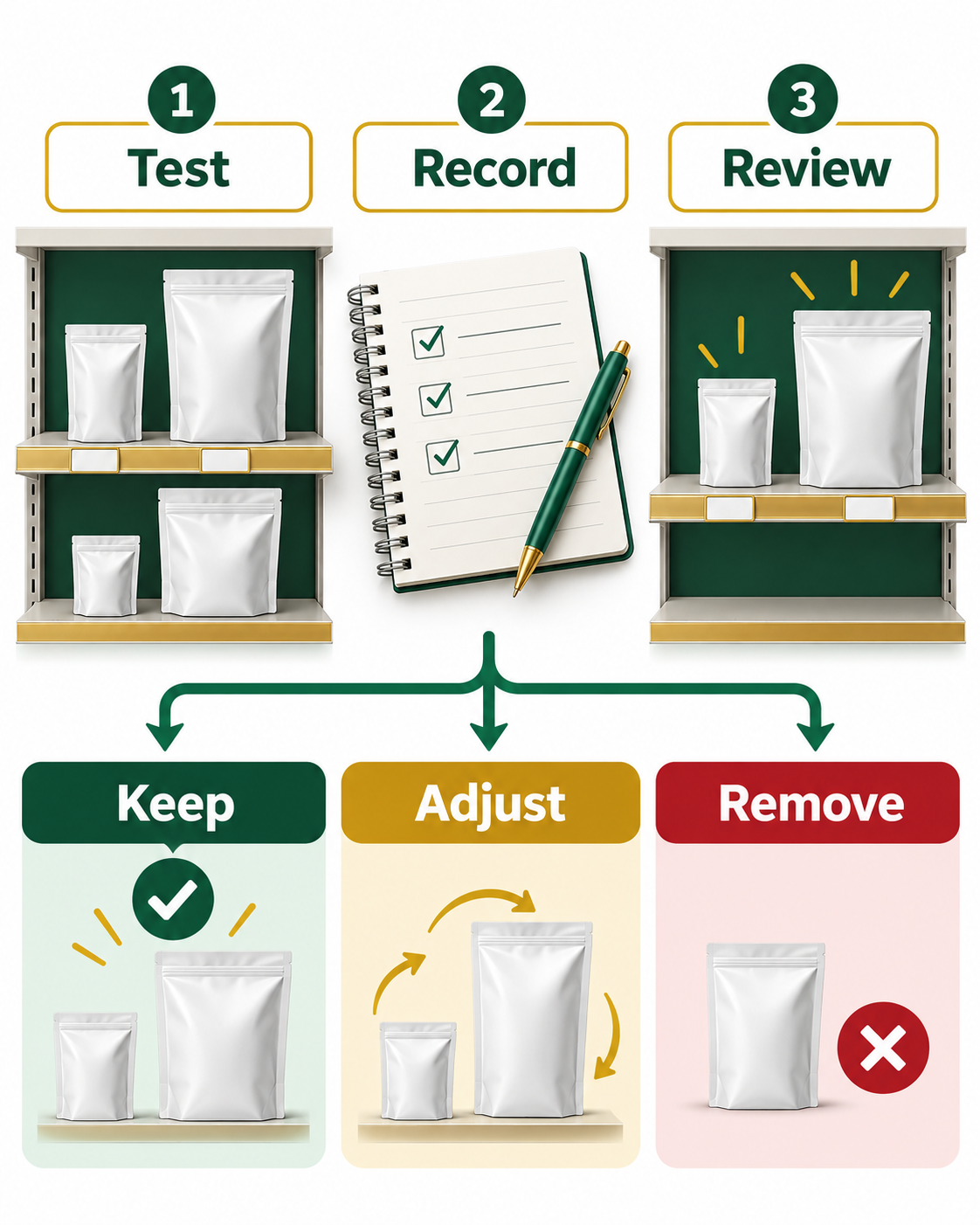
- Review the whole line: compare total contribution and customer coverage, then retain, adjust or discontinue the tested option.
Read the results without confusing popularity with extra demand
After the test, separate three outcomes: customers buying who previously could not find a suitable option, existing customers changing size, and customers buying more or less product overall. You may not be able to identify every purchase perfectly. That is acceptable. Use sales records together with anonymous observations, and avoid presenting a rough impression as a precise measure of consumer behaviour.
Check availability before interpreting weak sales. If the smaller pack was unavailable during your busiest period, its recorded sales understate what customers might have bought. Equally, a larger pack selling well while the smaller size was unavailable does not prove a lasting preference. Mark these periods clearly and, where necessary, repeat the test under more comparable conditions.
Then examine whether the added size has earned its place. Think about contribution, customer coverage, shelf space and operational effort together. A product that serves a distinct need may deserve retention even when it is not the fastest seller. But adding sizes indefinitely can create clutter, complicate ordering and make it harder for staff to keep labels accurate.
- Keep the size when it serves a clear buying occasion and its contribution supports the space and work involved.
- Adjust the test when visibility, pricing errors or interrupted availability prevented a fair comparison.
- Reduce duplication when two sizes serve much the same need and one adds little value to the range.
- Revisit the decision when supplier terms or observed customer needs change; a useful range is not permanently fixed.
Turn your findings into a precise wholesale enquiry
Once you understand the need, write an enquiry that a supplier can answer without guessing. Include the product category, the pack sizes you are considering, your location and the quantity you want quoted. Explain whether you are testing a new size or replacing an existing one. Ask for alternatives if the exact size is unavailable, but require the alternative's quantity and terms to be stated clearly.
For example, you might explain that your shop needs a manufacturer-packed household cleaner at a lower purchase amount, alongside an existing larger option. Ask which Kenyan-made sizes are available, how many packs come in a carton, and what commercial terms apply. This is more actionable than asking for a general catalogue and then trying to infer missing details from pictures.
Viwanda is currently an enquiry-led wholesale marketplace for Kenyan-made products only. Online checkout is available only for items stocked by Viwanda. For other listings, use the enquiry process to clarify availability and terms before proceeding. You can see how Viwanda works and prepare your requirements without assuming that a displayed product comes with a confirmed price, discount or delivery date.
The strongest pack-size decision is rarely 'small is best' or 'bulk is best'. It is a focused choice supported by customer requests, fair quantity comparisons and workable economics. Start with one product line, learn from a controlled test, and keep the options that genuinely help buyers. Ready to compare suitable Kenyan-made products? Send a wholesale enquiry with your preferred sizes, quantities and location, and request the details you need to make a clear purchasing decision.
Frequently asked questions
Are smaller packs always cheaper for customers?
They can require less money at the till, but they are not necessarily cheaper per kilogram, litre or item. Compare equivalent products using the stated net quantity. A customer may reasonably choose the smaller pack for affordability even when the larger one offers a lower unit price.
How many pack sizes should a small shop stock?
There is no universal number. Start with sizes that serve clearly different customer needs, rather than every option a supplier offers. Add a size when requests suggest a gap, then test it. Keep reviewing whether the extra choice justifies its shelf space, handling work and purchasing commitment.
Can I split a wholesale carton into individual retail packs?
First confirm that the inner packs are intended and appropriately labelled for individual retail sale. Opening an outer carton is different from repacking the product itself. If you plan to change the immediate packaging or divide the contents, seek guidance on the requirements for that product category.
Can I order different pack sizes through Viwanda?
You can enquire about Kenyan-made products and ask which sizes and order combinations are available. Mixed-size orders depend on the applicable supplier terms; do not assume they are offered. Viwanda is enquiry-led, and online checkout is available only for items stocked by Viwanda. Confirm details before committing.
Ready to take the next step?
Viwanda makes it straightforward to buy Kenyan-made goods wholesale or reach serious business buyers.
Enquire about Kenyan-made pack sizes