seller guide · manufacturing
Manufacturing in Kenya: How to Price a Wholesale Order Without Losing Money

Start with the real question: what must this order pay for?
A wholesale enquiry can sound like good news before you have checked whether it is good business. A shop wants branded cleaning products, a distributor needs household containers, or a hotel asks for locally made linen. Then comes the question every manufacturer hears: what is your best price?
The useful answer starts with another question: what must this particular order pay for? Your price should cover the resources needed to complete the work, a fair share of running the business, and profit. Copying another manufacturer's price cannot tell you whether your own workshop will earn anything.
This guide is for Kenyan businesses making products for wholesale buyers, whether production happens in a small workshop or an established factory. It focuses on repeatable product costing, not on guessing what buyers might accept. Market prices matter, but they should test your calculation rather than replace it.
Consider an illustrative business making reusable fabric shopping bags. A buyer requests a particular fabric, stitched handles and a printed logo. The order is not simply a quantity of bags. It includes fabric purchasing, cutting, sewing, printing, inspection and packing. Changes to any of those activities can change the cost.
Keep one costing sheet for each product specification and update it when important inputs change. You can browse Kenyan-made products to understand how comparable items are presented, but do not assume similar photographs mean identical materials or production costs. Your first task is to define what you are selling clearly enough that both the workshop and the buyer understand the same thing. That definition becomes the foundation of a price you can explain and defend.
Define the specification before you calculate a unit price
A price without a specification is an invitation to disagreement. Before costing, write down the product's material, dimensions, finish, packaging and intended quantity. If the buyer has supplied a sample, record whether it is a visual reference or the exact standard your production must meet.
Separate product requirements from service requirements. Custom printing belongs in the production specification. Delivery to the buyer's premises is a service requirement. Both may affect the quotation, but keeping them separate helps the buyer understand what changes when they request a different arrangement.
Ask about acceptance conditions early. Will the buyer approve a preproduction sample? What measurements or functional checks will matter? Are there particular labels or documents required? For regulated products, confirm applicable requirements with the relevant authority rather than relying on a buyer's informal description.
- Product: identify the material, grade, size, colour and finish being priced.
- Quantity: state the number of accepted units and how they will be packed.
- Branding: confirm artwork, print positions, labels and responsibility for approval.
- Quality: agree the sample, checks and treatment of units that fail inspection.
- Handover: clarify collection or delivery, destination and who handles unloading.
Build material costs around usable output, not purchases alone
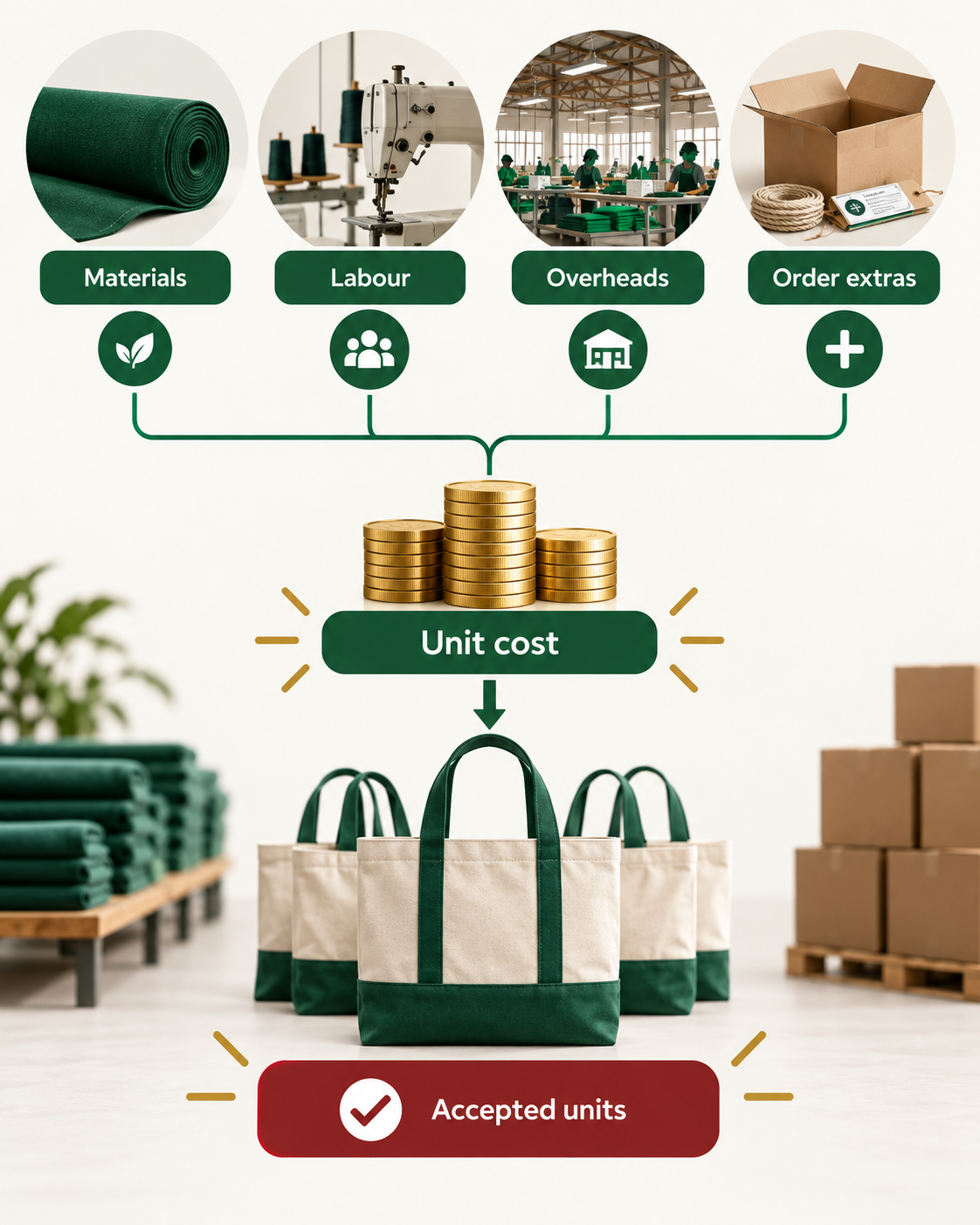
Your materials calculation should reflect what production actually consumes. For fabric bags, that includes the main fabric, thread, handles where separate, printing inputs, labels and packaging. Small components are easy to overlook because each seems cheap. Across an order, however, they can meaningfully change the margin.
Start with current purchase evidence: a supplier quotation, recent invoice or confirmed offer. Record whether transport to your workshop is included and whether a quoted amount includes tax. Use a consistent tax basis in your costing. Mixing tax-inclusive purchases with tax-exclusive purchases can quietly distort the result.
Next, account for normal production loss using your own records. Cutting creates offcuts; some material may be damaged during setup; certain units may fail checks. Do not invent a standard waste percentage because another workshop uses it. Measure a trial batch or review comparable production runs.
The important denominator is sellable output. If a batch consumes materials but produces fewer acceptable units than expected, the material cost per accepted unit rises. Record recoverable scrap separately and only credit a realistic recovery value. Offcuts sitting indefinitely in a corner are not cash earned.
Use a simple material table with columns for input, quantity needed, purchase unit, unit cost and total cost. Be especially careful when suppliers sell in rolls, kilograms or sheets while production uses metres, grams or pieces. Convert units before multiplying. Then add inward transport and other attributable purchasing costs once, not twice. For expensive inputs, note when the supplier's offer expires so your own quotation does not remain open longer than its cost assumptions. This makes later revisions easier to explain without turning every buyer conversation into an argument over price.
Pay for labour, machine time and the workshop itself
Materials are visible, so they often receive the most attention. Labour is just as real, including the owner's time spent doing production work. If you cut, sew, mix, assemble or supervise without assigning that work a cost, the business may appear profitable only because you are working unpaid.
Estimate direct labour from realistic production time. Include preparation, machine setup, cleaning between jobs and necessary inspection, not only the minutes when a machine is running. Use the actual employment cost relevant to your business, including applicable employer obligations, rather than assuming the take-home wage is the whole expense.
Then list overheads: workshop rent, security, administration, maintenance, insurance and other costs that support production. Some power use may be traceable to a specific machine or job; other utility costs may belong in overheads. Choose a sensible method and keep the same expense out of multiple categories.
Allocate overheads using a driver that reflects your operation. Labour hours may suit a labour-intensive workshop. Machine hours may suit equipment-heavy production. Divide the relevant overhead pool by realistic productive hours, then charge each order for the hours it uses. Do not base the calculation on a permanently full factory if actual utilisation is much lower.
Suppose two products use similar raw materials but one needs several machine changeovers and careful finishing. A flat materials-based markup may underprice the more demanding product. Time-based costing makes that difference visible. Review your allocation when output or operating conditions change, and investigate idle capacity separately. A pricing sheet should reveal inefficiency, not automatically pass every avoidable cost to the buyer. Over time, better scheduling and fewer stoppages may improve your margin without requiring a higher selling price.
Include the costs that belong to this buyer's order
Two buyers can request the same product and still create different costs. One accepts standard packaging and collects from your workshop. Another needs custom cartons, several approval samples and delivery to multiple locations. Quoting both buyers the same all-inclusive unit price can leave the more demanding order underfunded.
Separate one-off charges from recurring unit costs. A printing screen, mould, artwork preparation or special testing requirement may mainly relate to the first order. Decide whether to quote that expense separately or recover it across an agreed quantity. Explain what happens if the buyer orders fewer units than expected.
Compliance costs also need attention. Depending on the product, relevant expenses may include certification, testing, marking or record keeping. Check applicable requirements with KEBS and other relevant authorities. Allocate ongoing product compliance costs sensibly; do not charge every customer the entire annual expense unless there is a genuine order-specific reason.
- Development: prototypes, approved samples, artwork preparation and special tooling.
- Packing: branded cartons, protective materials, labels and pallet requirements.
- Handling: outsourced processes, loading and additional storage requested by the buyer.
- Distribution: agreed transport, insurance where applicable and destination-specific handling.
- Finance: borrowing costs or transaction charges directly associated with the agreed terms.
Choose a margin deliberately, then handle tax separately
Once you have the full order cost, divide it by the expected accepted units. This gives your cost per sellable unit before profit. Be clear about whether your cost base includes any taxes you cannot recover. Your accountant can help distinguish recoverable input VAT from amounts that genuinely remain a business cost.
Markup and margin are not the same. Markup measures profit against cost; margin measures profit against the selling price. Confusing them can produce a lower return than intended. If you want a particular gross margin, divide cost by one minus the margin expressed as a decimal.
For illustration only, suppose a product costs KSh 100 per unit and you target a 20% margin on the selling price. The calculation is 100 divided by 0.80, giving KSh 125 before any applicable output VAT. Adding 20% to cost instead gives KSh 120, which produces a lower margin.
This example is not a recommended margin or a market price. Your appropriate return depends on competition, product differentiation, production risk and the work involved in winning and serving the account. Test whether the proposed selling price is commercially realistic, then improve the specification or process if necessary rather than hiding missing costs.
Handle VAT according to your registration status and the product's tax treatment. Do not add VAT merely because a buyer asks for a VAT invoice. Equally, do not treat VAT collected as money available for profit. Confirm current tax and invoicing obligations, including applicable eTIMS requirements, through KRA. Your quotation should make clear whether prices include or exclude VAT and how applicable tax affects the total payable. Keep tax assumptions visible so a buyer does not mistake a tax-exclusive figure for the final invoice amount.
Turn the costing sheet into a usable wholesale quotation
The costing sheet is for managing your business. The quotation is for agreeing a transaction. Buyers do not necessarily need your internal wage rates or overhead calculations, but they do need enough detail to compare offers fairly and understand exactly what their payment will cover.
Keep the quotation readable. Identify the seller and buyer, date it, give it a reference and state the product specification. If you offer alternatives, show them separately. A cheaper fabric or plain packaging should appear as a different option, not as an invisible change to the original request.
Use the following sequence before sending the document. It works whether the enquiry arrived through a sales visit, a phone call or a marketplace. The purpose is to replace assumptions with a clear written offer that the buyer can review and your team can fulfil.
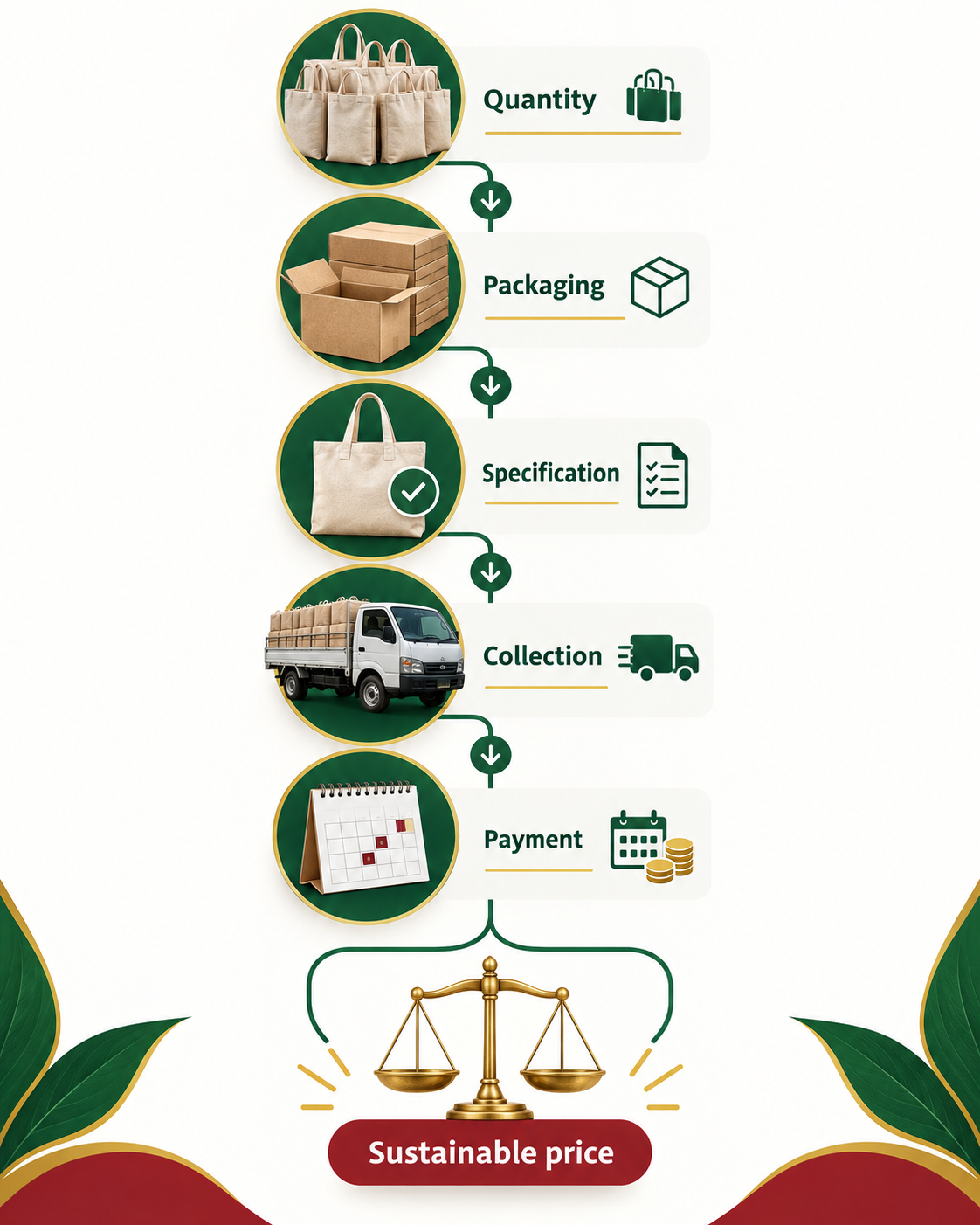
- Confirm the specification and quantity. Attach or reference the approved description, drawing or sample, and identify any details still awaiting buyer approval.
- Calculate the complete order cost. Include materials, production labour, overhead allocation and agreed order-specific expenses, checking for omissions and double counting.
- Set the commercial price. Apply your chosen profit approach, confirm the tax basis and show separate charges wherever that improves clarity.
- State payment and fulfilment conditions. Explain deposit requirements, balance arrangements, collection or delivery responsibilities, and when a production schedule can be confirmed.
- Set validity and approval rules. Give the quotation an expiry date and explain that specification changes require written review before production proceeds.
Negotiate quantity and payment terms without giving away the margin
When a buyer asks for a lower price, first identify what can genuinely become cheaper. A larger production run may spread setup costs across more units. Standard packaging may reduce handling. Earlier artwork approval may prevent rework. A lower price should ideally follow a lower cost or a clear commercial benefit.
Bigger orders do not automatically cost less per unit. They may require overtime, outsourced work, additional storage or purchases beyond your normal supplier credit. Calculate the proposed quantity rather than applying a discount simply because the number looks attractive. Quote quantity bands only where your production economics support them.
Payment terms can matter as much as unit price. If materials must be bought before production but the buyer pays well after acceptance, your business finances the gap. Map when money leaves and arrives. Consider whether the proposed deposit covers committed inputs, and assess the buyer's credit risk before agreeing deferred payment.
Ask what happens if approvals are late or goods remain uncollected. These situations can occupy space, delay other orders and tie up cash. Record any agreed storage or rescheduling conditions in advance. Do not invent charges after the event or assume the buyer has accepted terms you never shared.
A disciplined negotiation offers choices: standard rather than custom packaging, a different approved material, collection rather than delivery, or a payment structure that reduces financing pressure. Keep quality and compliance requirements intact. The aim is not to win every enquiry; it is to accept work your business can complete responsibly and profitably. If the requested price remains below a sustainable level, explain the gap calmly and offer a revised scope. Walking away from an unsuitable order can protect your ability to serve reliable customers.
“A wholesale price should explain how the order works, not hide what the workshop needs to survive.”— Dr. Chomba Chuma, Founder, Viwanda
Compare estimated costs with actual results after production
Your first costing sheet is an estimate, not the final truth. After completing an order, compare planned material use, labour hours, accepted output and outside charges with what actually happened. Record the reasons for differences while the production team still remembers them. A short review can improve the next quotation considerably.
Separate a pricing mistake from a production problem. If you forgot the branded carton, your estimating process needs correction. If unexpected machine downtime increased labour hours, investigate maintenance or scheduling. If the buyer changed the specification, check whether the change was approved and repriced before the extra work began.
Keep a simple history for repeat products. Record the specification version, main input costs, production yield and achieved margin on a consistent basis. This helps you identify products that look busy but earn little. It also gives your sales team a sound reason to refresh prices when purchasing or operating conditions change.
Bring that discipline into online enquiries. Viwanda is an enquiry-led wholesale marketplace for Kenyan-made products. Buyers and sellers still need to confirm specifications, availability, pricing and fulfilment arrangements. Online checkout is available only for items stocked by Viwanda; it is not the purchasing route for every listed product.
You can explore the manufacturer directory, learn how Viwanda works, or send a wholesale enquiry with a clear product description and quantity. If you manufacture locally, prepare your specification sheet and costing before responding to a promising lead. A clear enquiry and a complete quotation make it easier to discuss real options, avoid misunderstandings and build repeat business. Start with one frequently requested product this week: cost it properly, review the result and use that sheet as your template for the next order.
Frequently asked questions
What is the simplest formula for a wholesale manufacturing price?
Add materials, direct labour, allocated overheads and order-specific costs, then divide by accepted units to find unit cost. For a target margin, divide that cost by one minus the margin as a decimal. Apply tax according to your status and the product's treatment, and state any separately charged services clearly.
Should a small manufacturer include the owner's labour?
Yes. Production work performed by the owner still has an economic cost. Assign a reasonable cost to the time spent making the product, and account for management work consistently within overheads where appropriate. Otherwise, your price may support purchased materials and employees while leaving no sustainable payment for your own work.
Should I charge separately for samples and custom tooling?
You can quote them separately or recover them through an agreed production quantity. Explain the arrangement before work starts, including ownership and reuse of tooling where relevant. Separate charges often make repeat-order pricing clearer. Avoid promising that development costs will disappear unless the original agreement explains when and how they are recovered.
How often should I review wholesale prices?
Review the costing when material prices, specifications, labour requirements, tax treatment or fulfilment terms change materially. Also compare estimates with actual results after production. For an already accepted order, follow the agreed terms rather than changing the price unilaterally. Give new quotations a validity period linked to realistic input-cost assumptions.
Ready to take the next step?
Viwanda makes it straightforward to buy Kenyan-made goods wholesale or reach serious business buyers.
Send a clear wholesale enquiry