seller guide · distribution
Distribution in Kenya: How to Offer Retailers Credit Without Chasing Payments

1. Should your distribution business offer retailers credit?
A retailer wants another delivery today but promises to pay after the weekend. Your vehicle is already heading towards their shopping centre, and the salesperson wants the order. Should you supply? For Kenyan distributors, this everyday decision can determine whether a busy sales month leaves enough money to replenish the warehouse.
Retailer credit means supplying goods before receiving full payment. It can help reliable shops maintain availability and build lasting trading relationships. However, a sale on credit does not immediately create spendable cash. Until payment arrives, your business is financing part of the retailer’s operations while still meeting its own commitments.
The right question is therefore not simply whether credit increases sales. Ask whether your business can fund the delay, prove what the customer owes and collect payment without constant argument. A smaller paid order may serve your business better than a larger order that remains unpaid through several replenishment cycles.
This guide focuses on ordinary trade credit between a distributor and a retailer, not lending products or consumer finance. It provides practical operating controls rather than legal advice. Where a debt is disputed, significant or difficult to recover, a Kenyan advocate or qualified accountant can help assess the specific situation.
Start with a clear principle: credit is an agreed business facility, not an automatic reward for placing an order. You can maintain a warm relationship while requiring payment before delivery. The aim is not to distrust every shopkeeper; it is to make expectations clear before goods leave your control.
2. Decide how much unpaid business you can carry
Before discussing a customer’s limit, establish your own capacity to wait for money. List the cash commitments that fall due before likely collections arrive: supplier payments, wages, rent, vehicle costs and other essential expenses. Do not treat expected retailer payments as cash already available in your bank account.
Next, separate the money needed to keep operating from any amount you can safely leave outstanding. There is no universal credit percentage that suits every distributor. A business whose supplier requires advance payment has a different funding problem from one whose supplier offers agreed payment terms.
Set an overall ceiling for outstanding retailer credit as well as individual customer limits. Otherwise, many small approvals can quietly create a large funding gap. Include unpaid balances across all routes and salespeople; a customer does not become a separate risk simply because another employee takes the next order.
Use a simple weekly forecast rather than waiting for a month-end surprise. Write down opening cash, realistic collections, unavoidable payments and the resulting balance. Test what happens if an important customer pays later than expected. If that delay prevents essential purchases, the proposed credit exposure is too uncomfortable.
Keep a buffer for ordinary disruptions, including vehicle repairs and slower sales. Credit should not consume every available shilling. When the overall ceiling is reached, new orders can move to payment before dispatch until collections restore capacity. Explain this rule internally so sales staff do not promise exceptions casually.
3. Check the retailer and agree a sensible first limit
Assess the business that will owe you money, not only the person who calls. Record its trading name, relevant legal identity, shop location, buyer contact and accounts contact. Clarify whether the customer operates several outlets and whether payment comes from each outlet or a central office.
A physical visit can help confirm that the shop exists and understand its normal trading pattern. It cannot prove that the customer will pay. Likewise, registration documents identify a business but do not establish its financial strength. Combine basic identity checks with your own observed payment history.
For a new relationship, payment before delivery or on agreed delivery terms can establish a record before you consider credit. If you later approve a limit, begin with exposure you can absorb. Increase it because payments have been reliable, not simply because the retailer requests a bigger order.
Ask for references with the customer’s knowledge, and seek practical information about trading behaviour rather than gossip. Handle personal and business information carefully, restrict access and collect only what is necessary. A respectful assessment protects the relationship while giving your team a defensible reason for its decision.
- Confirm who is authorised to order and who is responsible for payment.
- Record the delivery location and a reliable contact for invoice queries.
- Review previous orders, actual payment dates and unresolved disputes.
- Agree an initial limit and identify who may approve changes.
- Keep the assessment accessible to authorised staff, not in one salesperson’s phone.
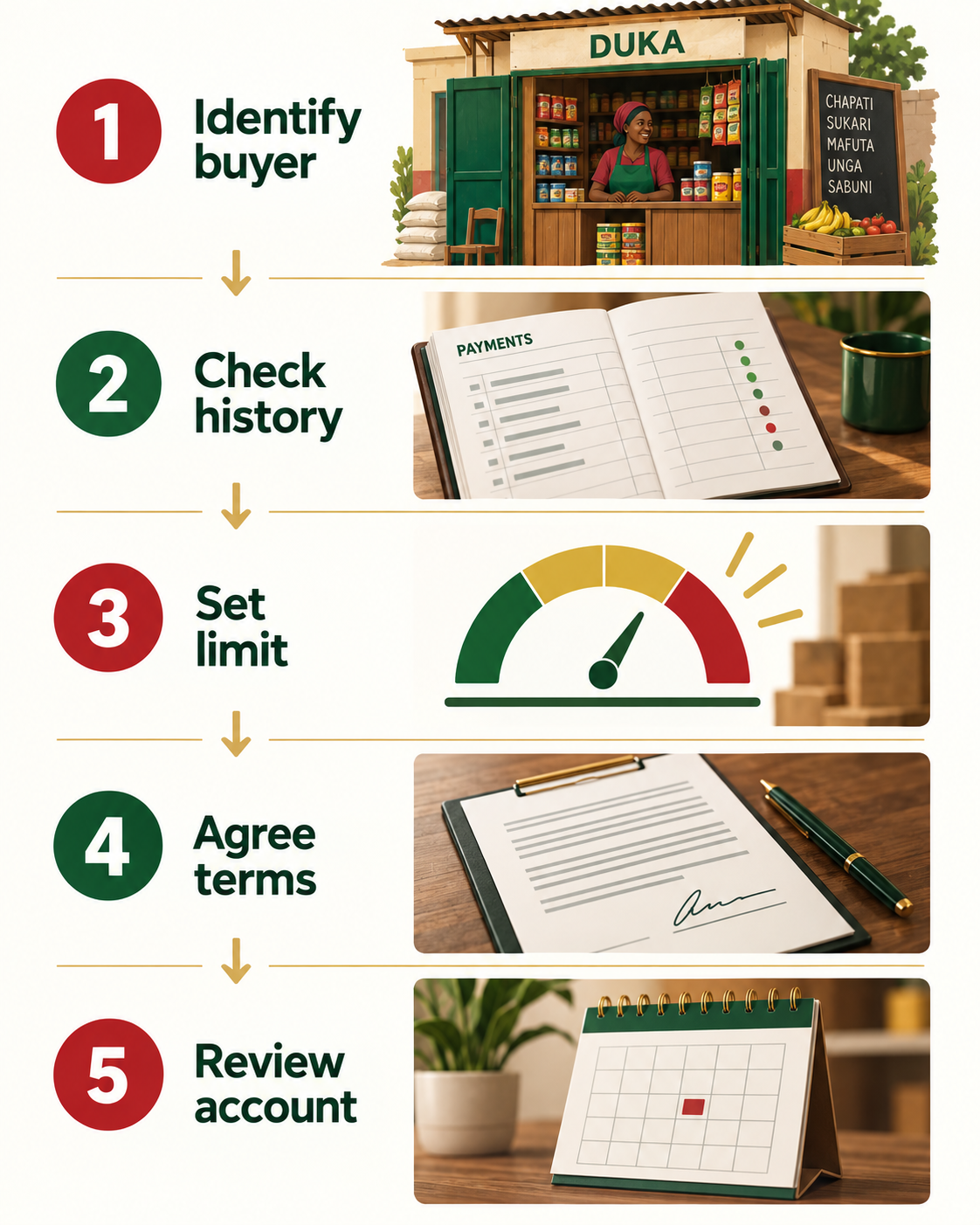
4. Put payment terms in writing before supplying
A useful credit agreement does not need complicated language, but it must remove ambiguity. State who is buying, the approved limit, when payment becomes due and how payment should be made. Make clear whether the payment period starts from the invoice date, delivery date or another explicitly agreed event.
Avoid loose phrases such as pay next week or clear the account soon. Put an actual due date on each invoice wherever possible. Also explain how weekends, public holidays and internal approval delays will be handled. The customer’s payment process should fit the agreement, not silently replace it afterwards.
Document how customers should report shortages, incorrect products or invoice errors. Agree how you will investigate and communicate the result. Do not assume that a signed delivery note resolves every possible product complaint. Equally, do not allow an unexplained complaint to remain indefinitely without an owner and a response date.
If you intend to charge interest, late fees or recovery costs, obtain appropriate advice and agree the terms before extending credit. Do not invent charges after an account becomes overdue. For substantial exposure, professionally drafted terms can address issues that a short message exchange may leave uncertain.
- Identify the buyer and the person authorised to accept credit terms.
- State the credit limit, due-date rule and approved payment channels.
- Explain the procedure for reporting and resolving delivery or invoice disputes.
- State when overdue balances will stop further credit supply.
- Record acceptance and give the customer a copy of the agreed terms.
5. Follow one approval process for every credit order
Good terms are useful only when dispatch follows them. A busy warehouse needs a straightforward release process that checks the customer’s balance before loading. The person taking an order should not assume that an earlier approval covers every future delivery, especially after missed payments.
Separate the commercial decision from the credit decision. Your salesperson can confirm product requirements, while an authorised person checks the account. In a small business, the owner may perform both roles, but the checks should still happen in a consistent order and leave a written record.
Use the following process for each proposed credit delivery. It works in a spreadsheet or a suitable business system, provided staff update the information promptly. The important point is that everyone uses the same balance, rather than choosing whichever message or notebook supports releasing the goods.
- Confirm the order: record products, quantities, delivery details and the customer’s authorised instruction before treating the request as ready for dispatch.
- Check the account: review unpaid invoices, due dates, pending credit notes and payments that have actually been verified.
- Calculate available credit: subtract the outstanding balance and already approved undelivered orders from the customer’s limit, without counting the same order twice.
- Resolve exceptions: require an authorised decision if the proposed delivery exceeds available credit or the account has overdue invoices.
- Release and document: issue the necessary sales documents, obtain delivery acknowledgement and send the invoice to the correct payment contact.
- Update immediately: enter the new balance, due date and follow-up responsibility so the next order is assessed using current information.
6. Keep delivery evidence and payment records together
Many collection problems begin as record problems. The shop says it received fewer cartons, the driver remembers a different quantity and the invoice sits in a salesperson’s messages. Your records should let someone who was not present understand what was ordered, supplied, accepted, adjusted and paid.
Give each transaction a clear reference that connects the order, invoice and delivery note. At delivery, record the recipient’s name, date and acknowledgement, alongside any shortage or visible issue noted at handover. Where another person receives goods on the buyer’s behalf, follow the authorisation arrangements agreed with the customer.
Send documents promptly to the person who processes payment, not just the shop attendant. Ask customers with formal purchasing procedures about purchase orders and invoice submission requirements before supply. An invoice can be commercially correct yet still sit unpaid because it never reached the right desk.
For tax invoicing, check current Kenya Revenue Authority requirements, including eTIMS where applicable to your business. A delivery note is not a substitute for any required tax invoice. Equally, having a tax invoice does not remove the need for useful delivery evidence and an accurate customer account.
Verify incoming payments through your own authorised banking or payment records. Do not rely solely on a screenshot forwarded by the customer. Allocate confirmed money to the correct account and invoices, then issue an acknowledgement. Keep access controlled and maintain backups so a lost phone does not erase the account history.
7. Review unpaid invoices before they become old debts
An aged receivables report is simply a list of unpaid invoices grouped by how long they have been outstanding or overdue. For collection decisions, make sure the report clearly distinguishes invoices not yet due from those past their agreed dates. A large balance is not automatically a late balance.
Review accounts at a regular time each week, with more frequent checks where exposure or order activity requires it. Start with invoices falling due soon, then overdue balances and unresolved disputes. Assign each action to a named person. A report that nobody acts on is only a tidy description of risk.
Send a courteous reminder before the due date when appropriate. Include the invoice reference, amount, due date and approved payment details. Ask whether the customer has all documents needed to process payment. This creates an opportunity to correct a missing invoice before it becomes an explanation for delay.
Once payment is overdue, seek a specific commitment rather than a general assurance. Record the promised amount and date, then follow up against that commitment. If the customer reports a dispute, capture exactly what is disputed and who will investigate it. Keep undisputed and disputed amounts clearly separated.
Pay attention to changing behaviour: repeated broken promises, unexplained deductions or requests for fresh deliveries while old invoices remain unpaid. None proves dishonesty, but each deserves review. Discuss these signals with sales staff, who may hear about shop closures or ownership changes before the accounts team does.
8. Collect overdue payments firmly and respectfully
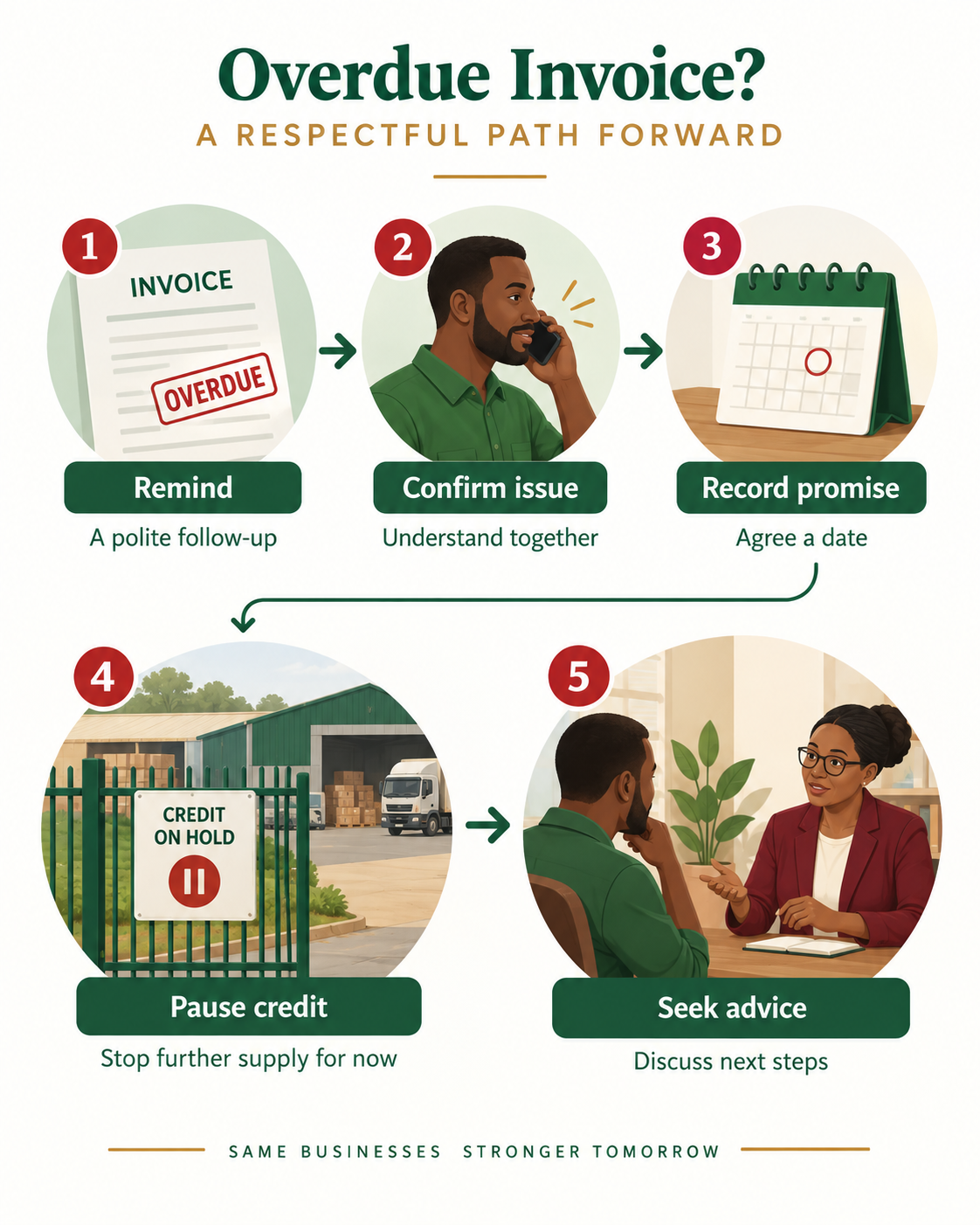
When a due date passes, contact the payment decision-maker privately and promptly. Begin with the facts: the invoice, delivery, balance and agreed date. Ask whether the problem is an administrative omission, a genuine dispute or a shortage of cash. Different problems require different solutions, not simply louder reminders.
If the customer cannot pay in full, consider whether a written repayment arrangement offers a realistic route to recovery. Specify amounts and dates, and record what happens to new orders. An instalment promise should not automatically reopen credit or erase the original debt from your records.
Pause additional credit according to your agreed terms and approval policy. If continued trading makes commercial sense, consider separately paid new orders, with clear allocation of those payments. Avoid arrangements where nobody knows whether incoming money settles old debt or pays for the next delivery.
Escalate proportionately when reasonable follow-up fails. A formal demand or legal action may be appropriate, depending on the evidence, value and circumstances. Seek Kenyan legal advice before choosing a recovery route. Do not threaten arrest merely because a commercial invoice is unpaid, seize property yourself or publicly shame the customer.
Keep a dated contact log and copies of responses. This helps your team avoid contradictory messages and supports professional advice if escalation becomes necessary. It also makes clear when further chasing is consuming more resources than expected. Review the accounting treatment of doubtful balances with your accountant.
“Good credit control protects the relationship by making payment expectations clear before there is a problem.”— Dr. Chomba Chuma, Founder, Viwanda — editorial view
9. Measure collections, not only sales made on credit
If your team celebrates only the value dispatched, it may overlook whether those sales produce usable cash. Review sales and collections together. A route with strong orders but repeated overdue balances needs attention even when its products move quickly off the warehouse shelves.
Useful measures include total outstanding credit, the amount overdue, the oldest unpaid invoices and customers above their limits. Also monitor promised payments that were missed and unresolved disputes. You do not need a complicated dashboard; a consistent weekly summary can reveal where intervention is needed.
Look at concentration as well as totals. If one retailer owes a large share of your receivables, their delay may disrupt the entire business. Consider exposure across related outlets where you know they share the same payer. Separate shop names can otherwise hide dependence on one payment decision.
Review staff incentives carefully. Rewarding dispatch alone can encourage pressure to approve weak accounts or ignore warning signs. A balanced approach considers legitimate sales, collections, accurate documentation and customer service. Any commission rules should be clearly communicated and handled consistently with employment arrangements and applicable requirements.
Use the review to improve decisions rather than assign blame. Ask whether limits need adjustment, documents arrive too late or particular disputes keep recurring. If reliable customers repeatedly pay after the agreed date, discuss workable terms rather than pretending the existing arrangement is functioning. Change terms deliberately and record acceptance.
10. Build credit control into your next wholesale enquiry
You can improve this process without buying new software immediately. Start with a customer register, an invoice list, a payment allocation record and a written credit policy. Make one person responsible for keeping the live balance accurate, while ensuring another authorised person can access it when needed.
Bring sales, warehouse and accounts staff together before introducing the policy. Walk through a realistic order, a part payment and an overdue account. Agree who can approve exceptions and how those decisions are recorded. A rule that changes whenever someone complains is difficult for both staff and customers to trust.
Use sourcing conversations to understand your own payment obligations too. When you browse Kenyan-made products, ask about order requirements, invoicing and payment terms before committing to a retailer’s request. Do not promise customer credit based on supplier flexibility that has not actually been agreed.
You can also explore Kenyan manufacturers and learn how Viwanda works as you plan suitable supply relationships. Viwanda is currently an enquiry-led wholesale marketplace for Kenyan-made products only. Online checkout is available only for items stocked by Viwanda; it is not the purchasing route for every listed product.
For your next order, send a wholesale enquiry with the product, quantity, destination and payment requirements you want to discuss. Confirm the resulting commercial terms directly before proceeding. Clear sourcing arrangements and disciplined retailer credit control work together: one protects supply planning, while the other helps turn deliveries into collected money.
Frequently asked questions
How many days of credit should a Kenyan distributor offer retailers?
There is no single period suitable for every business. Choose terms based on your cash commitments, supplier payment dates and the retailer’s demonstrated payment behaviour. Put the agreed period and invoice due date in writing. If your business cannot fund the delay safely, require payment before dispatch rather than copying another distributor’s terms.
Should I supply a retailer who has made a part payment?
A part payment reduces the balance but does not automatically restore credit approval. Confirm receipt, allocate it correctly and check whether overdue invoices remain. Then assess available credit and your supply-stop policy. If you accept a separately paid new order, document whether that payment covers the new goods or reduces the old debt.
Is a WhatsApp conversation enough evidence of a credit sale?
Messages can help record instructions and acknowledgements, but do not rely on them alone. Keep the agreed terms, order, invoice, delivery acknowledgement and payment history together. Preserve original records rather than selected screenshots only. Whether particular evidence is sufficient in a dispute depends on the circumstances; seek legal advice when recovery becomes contested.
Does Viwanda automatically offer credit on wholesale enquiries?
Do not assume that a listing or enquiry includes credit. Viwanda is enquiry-led, and payment arrangements must be confirmed for the proposed transaction. It lists Kenyan-made products only, with online checkout limited to items stocked by Viwanda. State your requirements in the enquiry and wait for explicit confirmation before making commitments to your customers.
Ready to take the next step?
Viwanda makes it straightforward to buy Kenyan-made goods wholesale or reach serious business buyers.
Send your wholesale enquiry