buyer guide · retail
Retail in Kenya: How Should You Change Shelf Prices When Supplier Costs Rise?

Start with the real question: which prices actually need to change?
A supplier sends a revised quotation while you are serving customers. Your next carton will cost more, but customers already know your shelf price. Should you increase it immediately, wait until the old stock finishes, or accept a smaller margin? For a Kenyan retailer, the useful answer starts with checking each affected product rather than increasing everything.
A higher supplier price does not automatically justify the same percentage increase on the shelf. The result depends on your present margin, transport costs, pack size, competition and how customers use the item. Some products may absorb a small increase temporarily. Others may already contribute too little to keep selling at the current price.
Separate three decisions: whether to reorder, what price to charge and when that price should take effect. Mixing them creates rushed choices. You might need a new shelf price without needing a larger order. Equally, a product might be unsuitable for your shop even after you increase its price.
This guide focuses on ordinary retail goods, including Kenyan-made household products, clothing and packaged items. Products subject to specific price controls or sector rules need additional checks. By Dr. Chomba Chuma, Founder, Viwanda, the approach below is designed for shop owners who need a simple, repeatable process rather than a complicated pricing system.
Keep one notebook or spreadsheet for the review. Record the evidence, your calculation and the approved change in the same place. That small discipline makes it easier to explain decisions to staff and spot mistakes before customers encounter them.
Confirm the supplier change before touching a shelf label
First establish whether the supplier has changed the product price or something else in the offer. A carton might contain fewer pieces, a quotation might now exclude transport, or a temporary offer might have ended. Comparing only the total invoice amount can hide the true reason your buying cost has increased.
Compare the previous and current offers for exactly the same product. Check the brand, size, variant and units per carton. For clothing or other assorted goods, confirm the mix as well. An assortment with different sizes or materials is not automatically comparable just because the supplier uses the same carton description.
Ask for the revised terms in writing, including when they apply and whether an existing confirmed order is affected. A dated message or quotation is easier to work with than a remembered phone conversation. Do not assume an earlier quotation remains valid until you have checked its terms with the supplier.
- Confirm the product name, specification, pack size and sellable units in each case.
- Check whether the stated amount includes applicable taxes and any agreed transport.
- Separate a lasting price revision from an expired promotion or conditional discount.
- Record quotation validity, minimum order requirements and the date new terms begin.
Calculate the cost of one sellable item, not just one carton
Your shelf price applies to the unit a customer buys, so your calculation must reach that same unit. Start with the purchase cost of the goods, add directly attributable inbound expenses, then divide by the number of sellable units. Keep the treatment of taxes consistent with your business's tax position.
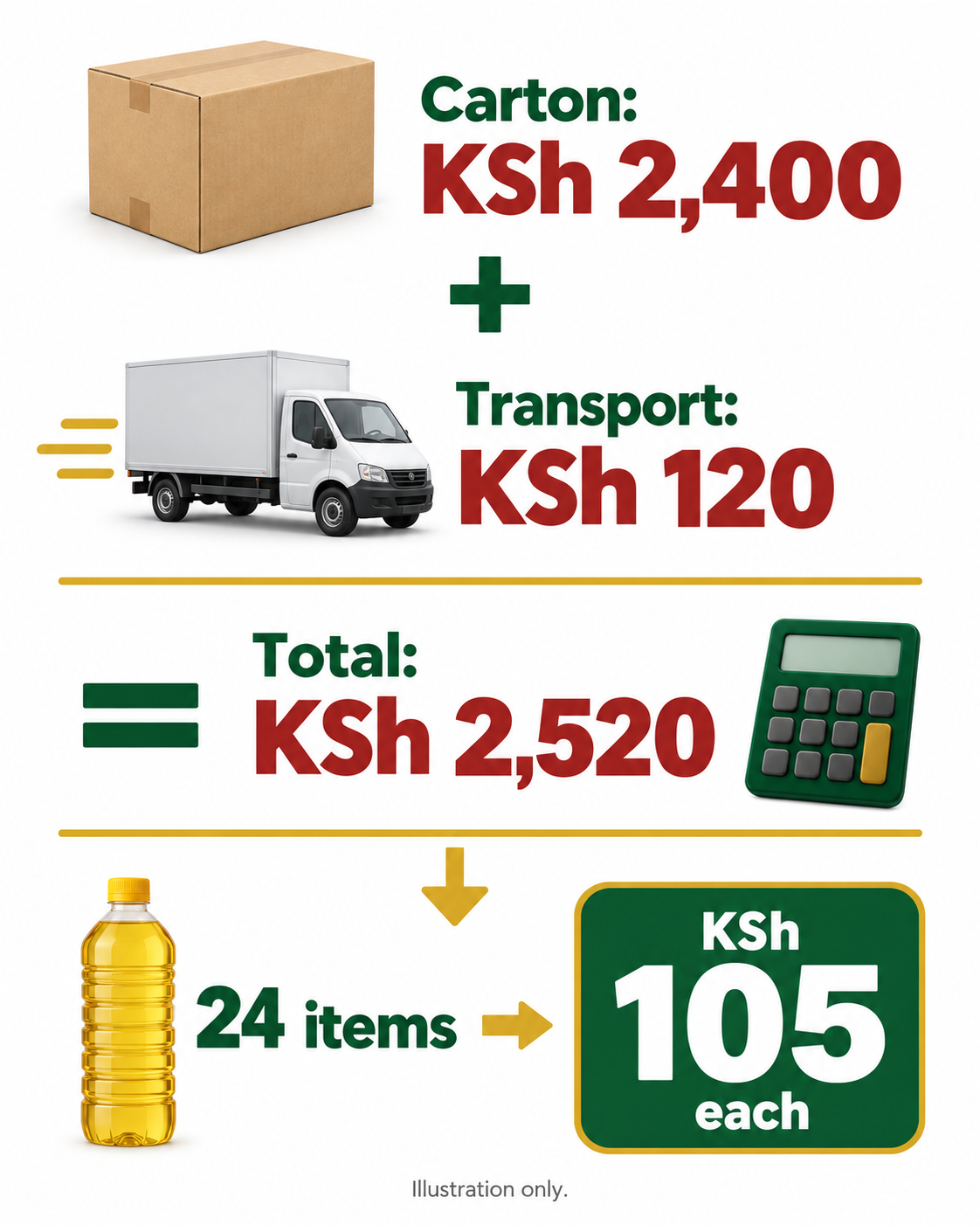
Consider an illustration, not a market quotation. A carton containing 24 identical items costs KSh 2,400. If transport allocated to that carton is KSh 120, the combined cost is KSh 2,520. Dividing by 24 gives KSh 105 per item. Using KSh 100 would ignore a real cost of getting the goods onto your shelf.
Where one delivery contains several products, use a reasonable allocation method. Weight, space or purchase value may be appropriate depending on what drives the transport bill. Apply the method consistently. Dividing transport equally between a small packet and a bulky carton can give you misleading product costs.
Do not silently spread disputed shortages or damaged units across every future purchase. Record those issues separately and pursue the agreed resolution. However, your pricing review should recognise predictable handling expenses that your business genuinely bears. Keep estimates visible so you can replace them with actual figures when available.
Tax needs particular care. Recoverable input VAT is treated differently from tax that forms part of your cost, and eligibility depends on your circumstances and supporting records. Check current guidance through the Kenya Revenue Authority and ask your accountant where necessary. Avoid comparing a tax-inclusive selling price with a tax-exclusive cost without adjusting the calculation.
Use margin correctly and check what remains for shop expenses
Margin and markup describe different things. Markup compares gross profit with cost. Gross margin compares gross profit with sales revenue. Confusing the two can leave you with less money than expected, especially when you copy a percentage from an old notebook without checking how it was calculated.
Using the earlier illustration, an item costing KSh 105 and selling at KSh 140 leaves KSh 35 before other shop expenses, assuming the figures use a consistent tax basis. The gross margin is 35 divided by 140, or 25%. The markup is 35 divided by 105, or about 33.3%. Neither figure is your final net profit.
To calculate a selling price from a chosen gross margin, divide the unit cost by one minus the margin expressed as a decimal. At a 25% margin, KSh 105 divided by 0.75 gives KSh 140. This is a calculation method, not a recommendation that every retailer should target that margin.
Rent, wages, electricity, payment charges and other operating expenses still need funding. You do not have to allocate every expense perfectly to every item before reviewing prices. However, you should understand whether the total gross profit from your product mix can reasonably support the shop.
After rounding a proposed price, calculate the margin again. Rounding down may seem harmless on one sale but matters across repeated transactions. Rounding up can affect customer acceptance. Write down both the proposed selling price and the resulting margin so the decision remains clear.
Decide how to handle stock bought at the old price
Existing stock raises a genuine choice. You paid the old cost, but replacing the item now requires more money. Keeping the old selling price may protect customer confidence for a while. Moving to a revised price may help finance replenishment. Neither approach should happen automatically without checking your figures and commitments.
Record both the actual cost of the stock you hold and the current replacement cost. The first supports proper stock and accounting records. The second helps you judge whether future sales will fund another order. Do not rewrite historical purchase costs simply because your supplier has issued a new quotation.
For identical goods on the same shelf, one clearly displayed selling price is usually simpler to manage than different prices based only on purchase date. If you choose to finish an old-price batch first, identify it clearly and establish a controlled changeover. Avoid leaving staff to guess which unit belongs to which batch.
Review any promises already made to customers, including accepted orders, deposits and advertised offers. Your internal decision to reprice should not quietly override an existing agreement. Where the position is uncertain, resolve it before accepting further payment or making a new commitment.
Set an effective date and record the reason for it. You might change prices before the next opening, after a defined promotion ends, or when a clearly identified batch is exhausted. The important point is consistency between the customer-facing price, the till and the instructions given to everyone who sells.
“A price change is not complete until the shelf, the till and the person serving the customer all agree.”— Dr. Chomba Chuma, Founder, Viwanda
Review customer-sensitive products separately from the rest
Customers do not notice every price equally. They may remember the price of a frequently purchased household item while comparing an occasional purchase mainly on quality or usefulness. Use your own sales records and conversations to identify sensitive products. Do not assume another shop's most important lines are also yours.
For each affected product, examine the likely consequence of holding or changing its price. A modest margin reduction might be manageable on a limited line, but dangerous across the entire shop. Equally, a higher unit margin is not helpful if demand falls enough to reduce your total gross profit.
Compare genuine equivalents in nearby shops or other channels. Note the size, quality, purchase conditions and any delivery charge. An advertised price for a different pack or a temporary clearance is weak evidence for your everyday shelf price. Competitor information should inform your judgement, not replace your own cost calculation.
- Protect visibility: review frequently purchased items that customers use to judge your shop.
- Check contribution: identify products whose current margin no longer supports continued stocking.
- Offer choice: consider a suitable Kenyan-made alternative without disguising differences in quality.
- Limit exceptions: give temporary price holds a review date and a clear financial boundary.
Compare sourcing options without quietly lowering the product standard
Before accepting a difficult shelf increase, ask whether the buying arrangement can improve without creating another problem. A different delivery arrangement, suitable order quantity or comparable local product may change your cost. Request fresh terms rather than assuming a larger order automatically earns a discount or saves money overall.
You can browse Kenyan-made products to identify possible alternatives, then prepare a like-for-like enquiry. State the intended retail use, size, material or formulation where relevant, and required pack configuration. A vague request for the cheapest option often produces offers that cannot be compared fairly.
Use the manufacturer directory and distributor directory to explore sourcing routes where relevant. Ask who supplies your area, what documentation accompanies the goods and what quantities they can discuss. Availability, payment arrangements and fulfilment details need confirmation for the particular enquiry.
Do not replace an established product with an apparently similar item while keeping labels or descriptions that imply nothing changed. Check identity, intended use and applicable product requirements. KEBS is the official starting point for information on Kenyan standards and certification; the requirements depend on the product concerned.
Viwanda handles Kenyan-made products only and is currently enquiry-led for wholesale. Online checkout is available only for items stocked by Viwanda. Treat a product listing as a starting point for discussion unless its purchasing route is clearly stated. Compare confirmed offers on total cost and suitability, not on an assumed platform price or delivery promise.
Change shelf labels and till records in one controlled session
The biggest operational risk is a half-finished update. A new till price with an old shelf label creates an avoidable dispute, while a new label with an old till entry loses the increase you intended. Schedule the change for a quieter period and give one person responsibility for completion.
Create a short change sheet showing the product identifier, old price, new price and effective time. Where products look similar, include size or variant. If you use a handwritten price book instead of a till system, it still needs the same disciplined update and checking process.
Keep the sheet after the change. It becomes the reference when a staff member asks about yesterday's sale or a customer brings an earlier quotation. If any item cannot be updated consistently, resolve that mismatch before presenting the new price as active.
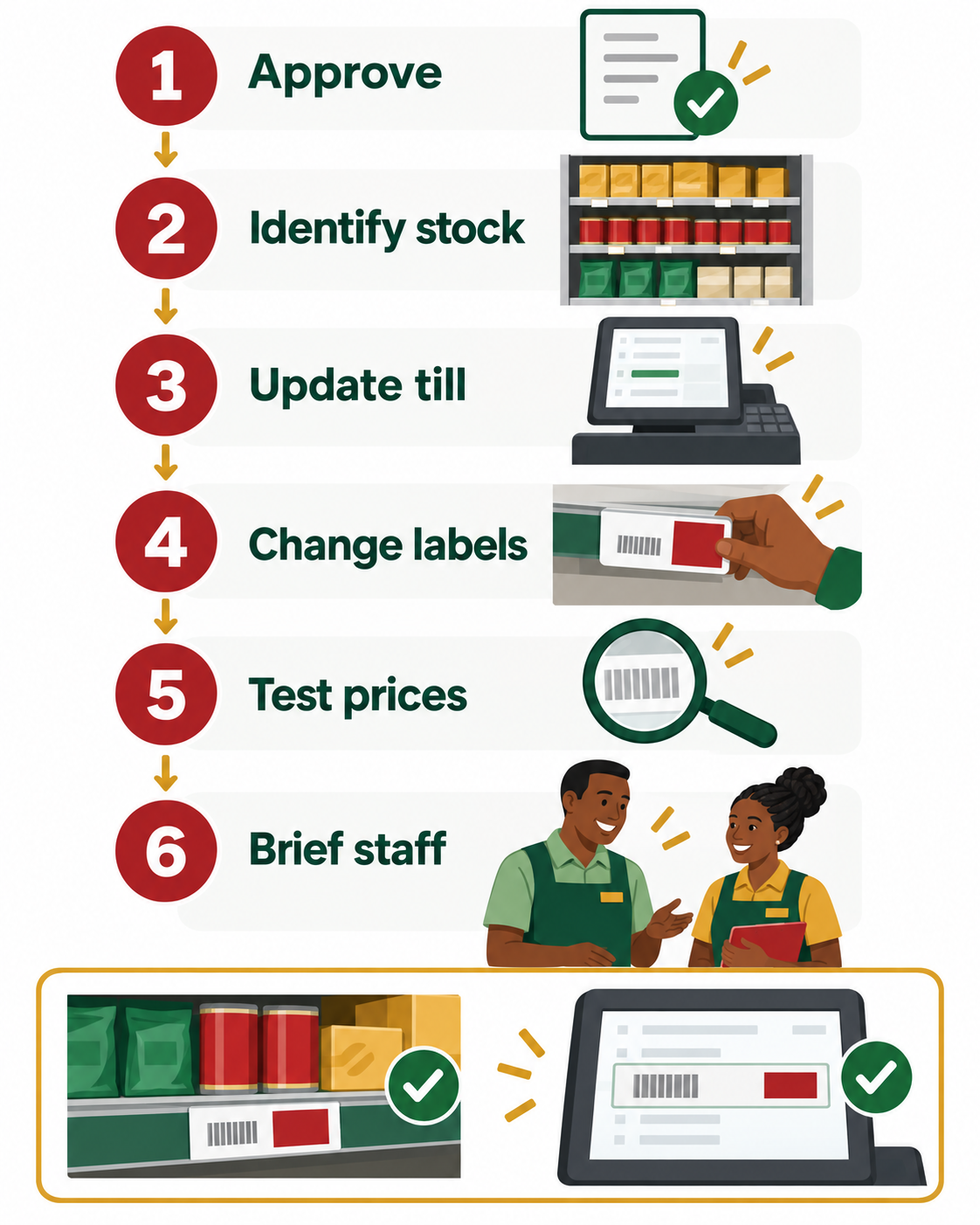
- Approve the affected products and final prices using confirmed unit costs and a consistent tax basis.
- Count or identify relevant shelf and backroom stock so overlooked displays do not retain old labels.
- Update the till, price book and any customer-facing digital catalogue controlled by your shop.
- Replace shelf labels and check promotional signs, counter displays and separately displayed variants.
- Test a sale or price lookup for each changed item and compare it with the visible label.
- Brief staff, record completion and check the first actual transactions for errors.
Explain the change clearly without blaming or pressuring customers
Customers need a clear price before deciding to buy. They do not need a long speech about every pressure on your business. Where a familiar item has changed noticeably, a brief explanation can help: the buying cost has changed, the displayed price is current, and staff can show available alternatives.
Keep the explanation truthful and specific. Do not describe an increase as a government requirement unless a relevant rule genuinely requires it. A supplier cost increase, a tax change and your own margin decision are different matters. Combining them into a vague claim can damage trust.
Prepare staff for three common situations: a customer remembers the old price, a shelf label was missed, or an earlier quotation is presented. Agree who can resolve each case and how the decision is recorded. Staff should not have to invent a policy while a queue grows.
If your own display is inconsistent, acknowledge the mistake and handle it fairly under applicable consumer requirements and your commitments. Correct the underlying record immediately. Arguing over who noticed the error first does not fix the next transaction and may turn a small issue into a lasting complaint.
Offer alternatives without making the customer feel embarrassed about their budget. Explain meaningful differences in size, material or performance, then let them choose. Do not quietly substitute another product or imply that a cheaper option is identical when it is not. Respectful service remains valuable even when prices are difficult.
Check the result and make the next review easier
A price update is a decision to test, not proof that the problem is solved. Review the affected products after enough ordinary trading has occurred to make a useful comparison. Slow-moving items need longer observation than daily sellers. Avoid drawing a strong conclusion from one unusually busy or quiet day.
Track units sold, sales value and gross profit on a consistent basis. Also record customer objections, substitutions and any time the product was unavailable. A fall in sales during a stockout is not evidence that the new price failed. A promotion or local event can also distort the comparison.
Look at the total result, not only the percentage margin. If a price increase improves the margin but sharply reduces sales, the product may contribute less overall. If sales hold but replenishment still strains cash, revisit order quantities, operating expenses and the accuracy of your unit cost.
Give temporary decisions an end point. A price held for customer-sensitive reasons should have a review date. A substitute product should be assessed for repeat demand and suitability. Keep the approved change sheet as a template so the next supplier revision does not trigger the same rushed discussion.
When you need new sourcing information, send a wholesale enquiry with product specifications, quantities and your business location. You can also read how Viwanda works before enquiring. Ask for the information needed to compare offers properly, then set your retail price from confirmed terms rather than guesswork.
Frequently asked questions
Should I increase every retail price by the supplier's percentage increase?
No. Calculate the new cost per sellable unit and review the margin on each affected product. Transport, carton contents and tax treatment may change the result. Customer sensitivity also differs across products. A blanket increase is simple to apply, but it can produce unsuitable prices and hide weak margins.
Can I keep the old shelf price until existing stock sells out?
That can be a commercial option, provided you account for applicable rules and existing commitments. Check whether the money generated will support replenishment at the new cost. Define the batch or changeover date clearly, and keep the shelf label, till entry and staff instructions consistent throughout.
How often should a small shop review its prices?
Review affected prices whenever confirmed buying costs or important trading conditions change. Also schedule a regular check that suits your product turnover. Reviewing does not mean changing every price. The purpose is to identify stale costs, incorrect labels and products that no longer contribute enough to justify stocking.
Can I order all wholesale products through Viwanda checkout?
No. Viwanda is currently enquiry-led for wholesale and lists Kenyan-made products only. Online checkout is available only for items stocked by Viwanda. For other wholesale requirements, submit an enquiry and confirm specifications, availability, price, payment terms and fulfilment arrangements before making your purchasing decision.
Ready to take the next step?
Viwanda makes it straightforward to buy Kenyan-made goods wholesale or reach serious business buyers.
Send your Kenyan-made wholesale sourcing enquiry