seller guide · manufacturing
Manufacturing in Kenya: How Do You Set Up Batch Numbers and Product Traceability?

Why batch traceability matters before your next wholesale order
A wholesale buyer calls about an unusual smell, a leaking container or a product that looks different from the last delivery. Can you identify when it was made, which materials went into it and who else received the same production run? That is the practical question batch traceability answers.
For a Kenyan manufacturer, traceability means connecting a finished product to its production history and its next buyer. A batch number is the visible reference that holds those connections together. On its own, however, a printed code tells you very little. Its value comes from the records behind it.
This matters whether you make packaged foods, cleaning products, personal care items or household goods. The risks and legal requirements differ by product, but the operating challenge is similar: avoid treating every item in your store as if it has exactly the same history.
Good records help you investigate complaints without guessing. They can also help you separate affected stock from unaffected stock, answer a distributor’s questions and identify recurring production problems. They do not prove that a product is safe, and they cannot replace quality checks or required approvals.
You do not need to begin with expensive software. A controlled notebook, clearly labelled stock and a backed-up spreadsheet may be enough for a small operation. The important thing is consistency across production, storage and dispatch. This guide shows how to build that connection, while leaving product-specific regulatory decisions to the relevant authority.
Start before an urgent complaint arrives. Reconstructing yesterday’s production from memory is difficult; reconstructing several weeks of mixed dispatches can be much harder. A small daily recording habit gives your team something dependable to work with when a buyer needs an answer.
Check your product’s requirements before designing the label
First, identify exactly what you manufacture and how it is sold. Requirements can differ between food, cosmetics, detergents, electrical products and other goods. A labelling approach that suits one category may be incomplete or inappropriate for another. Do not copy a competitor’s pack and assume it is compliant.
Ask the Kenya Bureau of Standards which standards, certification requirements and labelling provisions apply to your product. Depending on the category, you may also need guidance from another competent regulator. Use current official guidance rather than an old social media checklist or an informal assurance from a packaging printer.
Keep several questions separate. Does the product require a batch or lot identifier? What information must appear on the consumer pack and outer carton? Are manufacturing dates, expiry dates, instructions or warnings required? What rules govern any certification mark? These are related questions, but they are not interchangeable.
A batch code is not a KEBS permit number, a barcode or an expiry date. Each serves a different purpose. Never print a certification mark or claim an approval you have not obtained. Also, do not use a convenient date as an expiry date without a properly established basis.
Before ordering printed packaging, prepare a sample layout and confirm the applicable requirements. Leave a suitable area for variable information such as batch codes. Check whether the selected ink, label or stamping method remains readable under the product’s normal handling and storage conditions.
Keep a compliance file with the guidance received, applicable documents, approved label artwork and the date of review. Assign someone to check changes when you introduce a new formulation, pack size or product category. This protects you from repeating an old label design after the underlying product has changed.
Define what counts as one batch in your workshop
Before choosing a code, decide what the code represents. A batch should describe a defined quantity made under recorded conditions. In a small mixing operation, it might be one vessel load. In another process, it might be a controlled production run with clearly recorded start and finish points.
Avoid defining a batch as everything made during a week simply because that is easy to write down. If materials, equipment settings or processing conditions change within that period, the code may cover too many different histories. Investigating one problem could then involve a large amount of stock.
Equally, making every individual item a separate batch can create unnecessary work where unit-level tracking is not needed. Choose a practical boundary based on your process, product risks and applicable requirements. Ask a qualified technical adviser where the appropriate boundary is unclear.
Write down the events that trigger a new batch. Your team should not have to invent a rule during a busy afternoon. Depending on your process, consider these boundaries:
- A new mix or vessel load starts, with its own recorded material quantities.
- A formulation or product specification changes, requiring a distinct production record.
- A significant interruption or process deviation requires separation and review.
- An input lot changes, where your procedure requires a new batch boundary.
Use a simple code that stays unique and readable
A useful batch code is easy to write, easy to read and difficult to confuse with another code. It does not need to contain your whole production history. A short identifier linked to a complete register is usually more workable than a long string that staff repeatedly copy incorrectly.
For example, a hypothetical manufacturer could use CL-20261103-02 for the second recorded cleaner batch on that date. This is an illustration, not a prescribed format. The product reference, date and sequence should follow your written rules, and the same code must never identify two different batches.
A date alone can fail when you make several runs in one day. A product name alone can fail when the same product is produced repeatedly. Decide how your code handles multiple production lines, overnight runs and more than one site, where those situations apply.
Keep the code distinct from other information on the pack. Staff and buyers should be able to tell which marking is the batch identifier. Test legibility after ordinary handling, not only immediately after printing. Curved bottles, dusty sacks and damp surfaces can expose weaknesses in your chosen method.
Set a rule for correcting coding mistakes. Do not quietly overwrite the register or apply a new label without recording what happened. Preserve the connection between the original identification, the correction and the stock involved. Otherwise, a correction intended to improve accuracy can destroy the trail.
Give responsibility for issuing codes to a named role, with a backup person. Keep unused labels controlled and remove obsolete examples from the production area. A clear format helps, but disciplined use matters more. The best code is the one your team applies correctly every time.
“A batch number is useful only when your team can follow it from materials to the buyer.”— Dr. Chomba Chuma, Founder, Viwanda — editorial view
Build the record trail in six practical steps
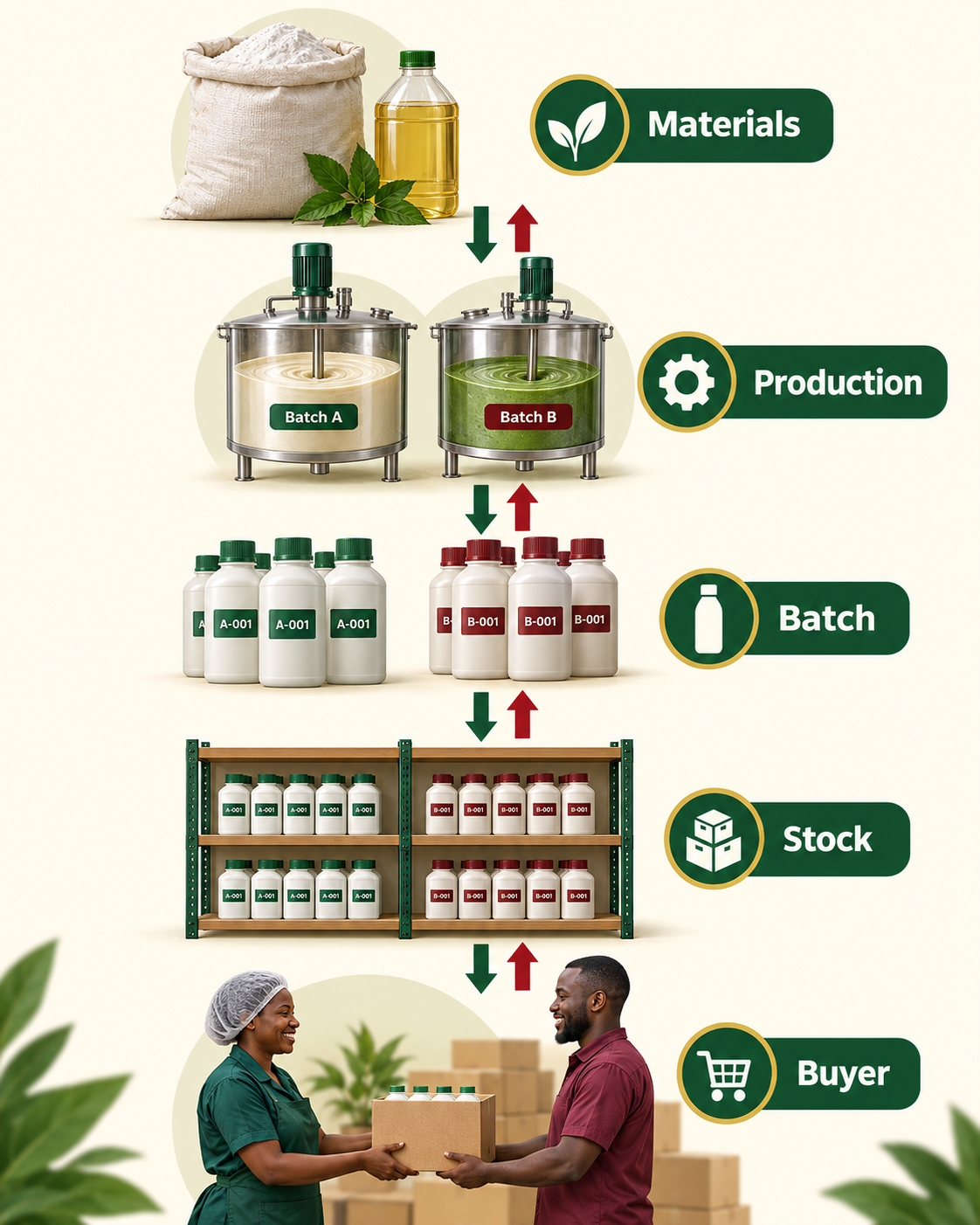
Your system needs to follow the physical movement of goods. Recording everything at the end of the week invites gaps, especially when materials are shared across products or finished stock leaves soon after packing. Put the relevant form where each activity happens and record information during the work.
You can use separate sheets linked by batch code rather than one crowded document. The aim is to retrieve the full history reliably. These six steps provide a starting structure; adapt the fields to your product, process and regulatory obligations.
- Record incoming materials. Capture the supplier, material description, receipt date, quantity, supplier lot reference where available, and your internal receipt reference. Keep supporting delivery documents connected to the entry.
- Record materials issued to production. Link each input lot and quantity to the finished batch. Include relevant packaging materials, particularly where the container, closure or label could affect quality or identification.
- Record the production run. Enter the batch code, product specification or formulation version, production date, responsible staff, equipment reference where useful, and the process checks required by your procedure.
- Record the output and its status. Show the quantity produced, rejected, held for review and released. Identify who authorised release and connect any relevant test or inspection results to the batch.
- Record packing and storage. Note the pack sizes, quantities and stock location. If a bulk batch is divided into packing runs, preserve the relationship between the bulk batch and every finished pack.
- Record dispatch. Link the batch and quantity to the buyer, dispatch date and delivery document. Where one order contains several batches, list them separately instead of recording only the total order quantity.
Keep batch identity intact through packing and dispatch
Many traceability gaps appear after production is complete. Staff may combine loose units from different runs into one carton, replace damaged packaging or move stock without updating its location. The original production record can be accurate while the dispatch record still gives the wrong picture.
Make batch identity visible wherever stock waits. Mark shelves, bins or pallet positions as appropriate, and distinguish released stock from stock on hold. Physical separation is especially useful in a small store where the same person receives materials, packs goods and prepares customer orders.
Mixed cartons need a deliberate rule. If you allow different batches inside one carton, the records and identification must preserve that detail in a way suited to your product and requirements. If your system cannot handle it reliably, avoid mixing batches until it can.
Repacking and rework also need written controls. Do not give goods a fresh identity that hides their earlier history, and never treat repacking as a reason to extend shelf life automatically. Where rework is permitted, record the original batches, quantities, destination batch and authorisation.
At dispatch, compare the actual pack markings with the picking record. An invoice naming only the product may be insufficient for your internal traceability needs. You can maintain a separate batch dispatch register linked to the invoice or delivery note, provided the connection is clear and retrievable.
Discuss the information handover with wholesale buyers before regular supply begins. When approaching Kenyan distributors, explain how your batches are identified and where the code appears. Ask whether they can retain batch references when goods move onwards. Your direct records may stop at your buyer, but their cooperation helps extend the trail.
Test the system before a complaint tests it for you
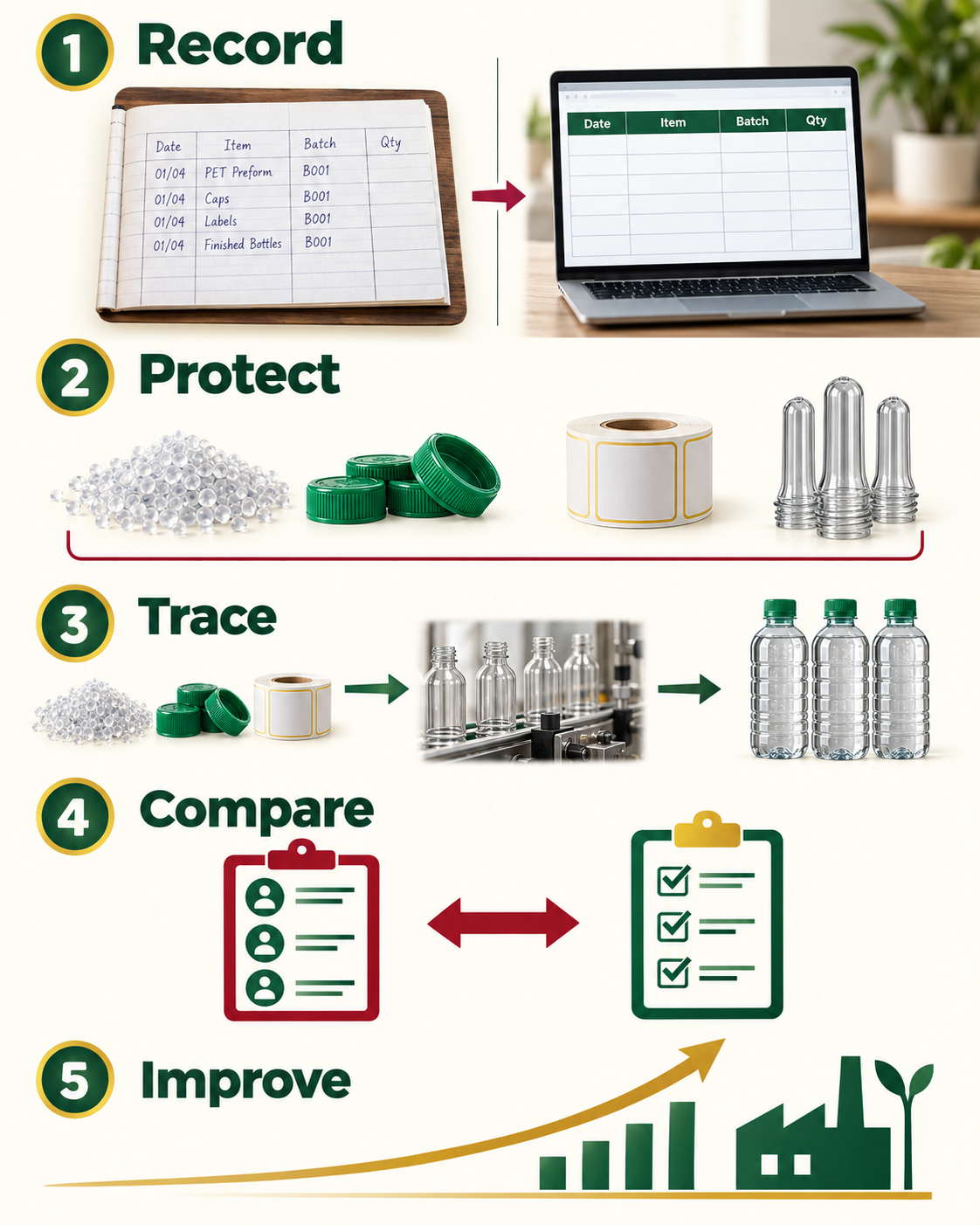
A traceability system is not proven by the number of forms you keep. It is proven by whether someone can use those forms to answer a real question. Run a practice exercise using an actual batch already produced, stored or dispatched, rather than a perfect fictional example.
Start with one finished pack. Ask a staff member to find its production record, material inputs, release decision and dispatch history. Then reverse the exercise: select an incoming material lot and identify every finished batch that used it. Both directions matter.
Compare quantities as well as references. The recorded output should be explainable through stock remaining, dispatches, samples, rejects and other documented movements. Where processing changes weight or volume, use the appropriate production basis rather than expecting unlike units to match directly.
If you discover a real concern, distinguish investigation from confirmed conclusions. Identify potentially affected stock, place appropriate holds and seek competent technical advice. A safety issue may require notification, withdrawal or recall under the applicable rules. Do not assume a message to one buyer completes your obligations.
Keep a simple incident contact list with production, quality, management and buyer contacts. Agree who can stop dispatch, who assesses the issue and who communicates externally. During an incident, unclear authority can delay action even when the records are good.
After every exercise or actual incident, record what was missing and change the procedure. Perhaps a carton marking was unreadable, a dispatch entry omitted the batch or one material receipt lacked identification. Fix the specific weakness, train the relevant people and repeat the test. Treat this as routine improvement rather than a search for someone to blame.
Choose tools your team can maintain every working day
Start with the simplest reliable tool, not the most impressive demonstration. A bound register can work where production is limited and responsibilities are clear. A spreadsheet can improve searching and summaries. Dedicated software becomes useful when the number of products, sites or movements makes manual control difficult.
Whatever you choose, protect the records from accidental loss and uncontrolled editing. Paper needs secure storage and sensible copies. Digital files need backups, appropriate access and a method for keeping correction history. One phone containing the only photographs of production sheets is a fragile system.
Make the working language and layout understandable to the people entering information. Use clear field names, agreed units and examples from your own products. Train relief staff too; a system that works only when the owner is present will struggle during leave or a busy production period.
Before adopting a tool, check these practical points:
- Can staff capture information at the work area, including when internet access is unavailable?
- Can you search by finished batch, material reference and buyer without rebuilding the records?
- Can corrections remain visible, with the responsible person and reason recorded?
- Can you export or retrieve your information if the service or device becomes unavailable?
Turn traceability into a stronger wholesale conversation
Wholesale buyers need confidence that repeat orders will arrive with consistent identification and usable supporting information. You do not need to share confidential formulations to demonstrate this. Explain your batch coding method, your release process and the records you can provide for the particular product.
Prepare a short product information sheet that agrees with your actual packaging and approved claims. Include the product description, pack configuration, storage guidance where applicable and the location of the batch code. Keep commercial documents and technical information aligned so buyers do not receive conflicting instructions.
When listing alongside other Kenyan manufacturers, treat traceability as an operating capability, not a vague quality slogan. Say what you genuinely do. Avoid implying that a batch register itself establishes certification, guarantees safety or proves every possible quality claim.
Buyers can browse Kenyan-made products on Viwanda and raise specific sourcing questions. Viwanda is currently enquiry-led wholesale and carries Kenyan-made products only. Online checkout exists only for items stocked by Viwanda; other wholesale requirements should begin with an enquiry and confirmation of the relevant details.
For your next order, start with one product and check its whole journey. Confirm the applicable requirements, define its batches, assign codes, connect the records and run a tracing exercise. Once the method works, extend it carefully to other products instead of copying unresolved gaps across the business.
Ready to discuss wholesale supply? Send a manufacturing or sourcing enquiry with the product, intended quantity, pack size and destination, plus any documentation or batch-information needs. Clear requirements make the conversation more useful. Confirm availability, commercial terms and logistics for the actual enquiry rather than relying on assumptions about what a listing includes.
Frequently asked questions
Is a batch number compulsory for every Kenyan-made product?
Do not assume one rule covers every category. Requirements depend on the product and applicable standards or regulations. Ask KEBS and any relevant sector regulator about your exact product, including the consumer pack and outer packaging. Internal traceability can still be useful even where a particular marking is not required.
Can I use a spreadsheet instead of buying traceability software?
Yes, if it reliably connects materials, production, stock and dispatch records for your operation. Use controlled access, backups and a clear correction procedure. Test retrieval regularly. Move to a more capable system when complexity makes your current method unreliable, not simply because another manufacturer uses expensive software.
Does a retail barcode replace a batch code?
Not necessarily. A common retail barcode identifies a product type, while a batch code identifies a particular production grouping. Some barcode systems can encode batch information, but that requires suitable design and handling. Scanning a product barcode alone does not establish a traceable production history.
How long should a manufacturer keep batch records?
Set retention periods using applicable legal requirements, product life, buyer agreements and technical advice. There is no single period suitable for every product. Include material, production, release and dispatch records in the policy, and make sure they remain readable and retrievable throughout the required retention period.
Ready to take the next step?
Viwanda makes it straightforward to buy Kenyan-made goods wholesale or reach serious business buyers.
Start your Kenyan-made wholesale enquiry