seller guide · Growth, digital selling & exports
How Viwanda Helps Kenyan Manufacturers Sell Wholesale Online

1. Understand what selling wholesale on Viwanda means
By Dr. Chomba Chuma, Founder, Viwanda. For a Kenyan manufacturer, selling online should begin with a clear understanding of the sales process. A product listing can introduce your business, but a wholesale buyer usually needs a conversation before committing. Quantities, packaging, specifications and transport all influence whether an enquiry becomes an order.
Viwanda is currently an enquiry-led wholesale marketplace for Kenyan-made products. This means sellers should prepare for questions and quotations, rather than assume that every buyer will immediately pay through a shopping cart. Online checkout exists only for items stocked by Viwanda. A listed product is not necessarily a Viwanda-stocked product.
That distinction matters when you explain the process to your team. Someone needs to receive questions, establish what the buyer needs and confirm what your business can supply. Listing products is one part of selling; managing the conversation is another. Neither visibility nor an enquiry guarantees a completed sale.
Buyers can browse Kenyan-made products, while sellers can use how Viwanda works as a starting point for understanding the marketplace. Before relying on a particular feature, ask whether it applies to your products and selling arrangement. This is especially important for payment collection, stockholding and delivery.
The practical opportunity is straightforward: make your products easier to understand and your business easier to approach. Start with accurate information, then carry that accuracy through every discussion. The following workflow explains how to prepare, what to confirm and where sellers should avoid making assumptions.
2. Prepare for onboarding with a complete supplier file
Treat onboarding as preparation for a business relationship, not simply filling in a profile. Because Viwanda focuses on Kenyan-made products, be ready to explain what you manufacture locally and where production takes place. If your business also sells imported finished goods, separate those from the products you propose for this marketplace.
Prepare a simple supplier file before you contact Viwanda about selling. The exact information requested should be confirmed with the team; do not assume that the checklist below is an official approval standard. It is a practical way to reduce missing details during the initial conversation.
Your business name, contact details and trading documents should tell a consistent story. Where a brand name differs from the registered business name, explain the relationship clearly. Assign a contact who understands production and can obtain approval for quotations, rather than leaving important questions unanswered between departments.
- Record your business identity, manufacturing location and the person authorised to discuss wholesale supply.
- Prepare product names, current photographs, specifications, pack sizes and realistic production information.
- Gather relevant registration, tax and product compliance documents, checking that they are current.
- List your supply limits, including minimum quantities, customisation constraints and areas you can serve.
3. Build listings that answer wholesale buying questions
A useful wholesale listing helps a buyer decide whether to ask for a quotation. Start with a plain product name and a description of its intended use. State the material, size, finish or grade where relevant. Avoid broad claims such as premium quality unless you can explain what the buyer will actually receive.
Show the product as supplied, not only as styled for a photograph. A food processor might show the individual pack and outer carton. A furniture maker might show dimensions, joints and finish options. Use your own accurate photographs, and identify any sample image that differs from the final specification.
Make the unit of supply unmistakable. A piece, pair, kilogram, bale and carton are not interchangeable. If quantities vary by colour or size, explain that too. A buyer asking for twenty cartons needs to know the contents of each carton before comparing your offer with another supplier.
- Describe the product specification and available variations in language a purchasing officer can use.
- Explain pack contents, ordering units and any minimum quantity that applies to the proposed supply.
- Distinguish available stock from products made after an order is confirmed.
- State what requires a quotation, including custom branding, unusual packaging or a different specification.
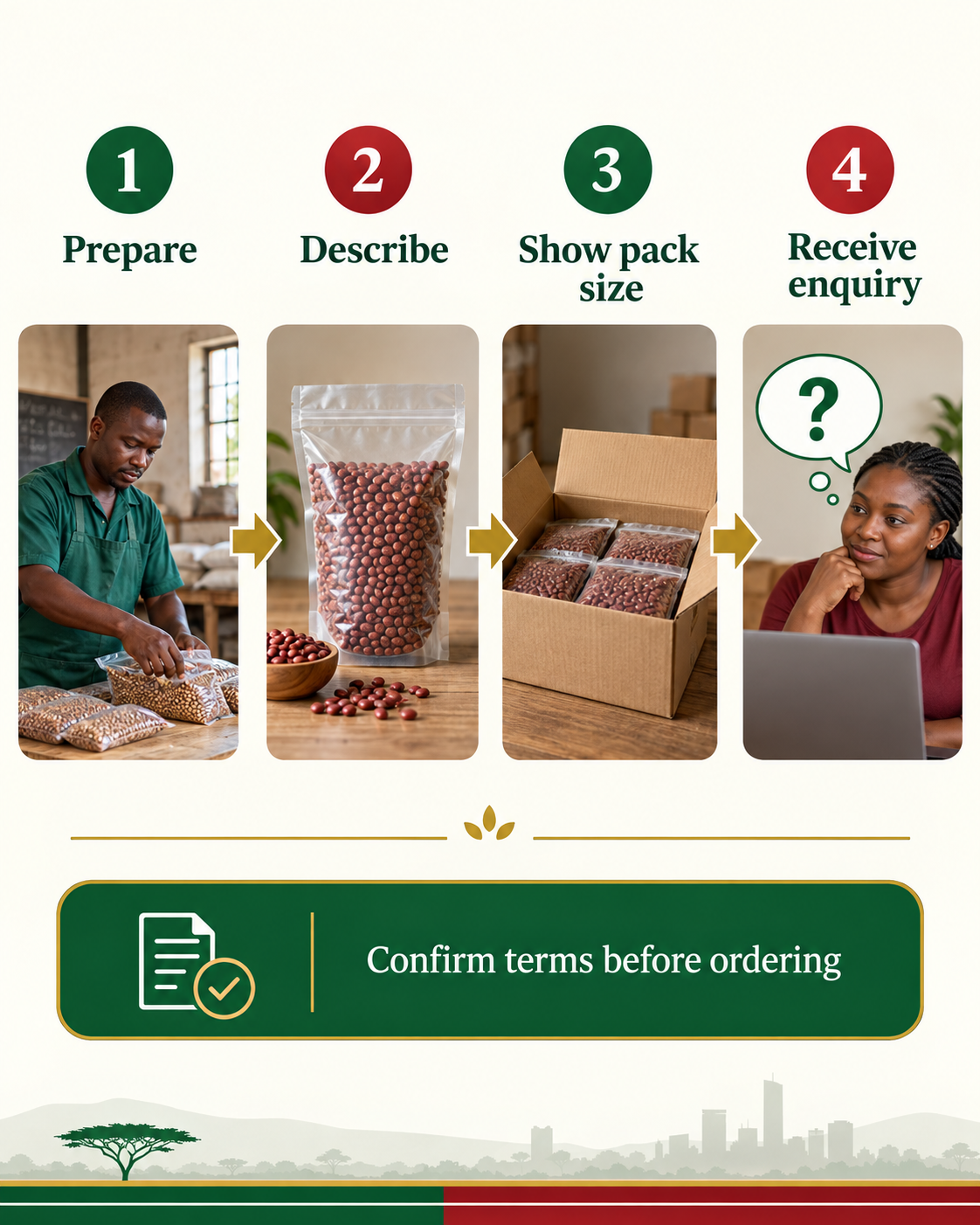
4. Turn an enquiry into a properly defined requirement
An enquiry is an expression of interest, not permission to manufacture or dispatch. Some buyers are researching suppliers, while others have an immediate requirement. Your first job is to understand which conversation you are having. A helpful response should clarify the need without pressuring the buyer or promising what you have not checked.
Ask about the product, quantity, intended use, destination and required date. For customised goods, request the relevant artwork, dimensions or specification. If the buyer wants a sample, agree its scope, cost and transport separately. A sample request and a production order should not be treated as the same instruction.
Confirm whether the person enquiring can approve the purchase or is collecting information for someone else. Schools, shops, hotels and distributors may have different approval processes. Understanding those steps helps you supply the right documents and follow up appropriately, without mistaking an internal discussion for a firm commitment.
Keep a written summary of what the buyer has requested. For example, distinguish branded cartons from plain cartons and a single delivery from several drop-off points. Small differences can change production work and transport arrangements. Where something remains unclear, label it as awaiting confirmation instead of quietly making an assumption.
If you cannot meet the requirement, say so early and explain any suitable alternative. A truthful answer protects both businesses from wasted effort. For enquiries received through Viwanda, confirm the agreed communication route and who will handle follow-up. Do not assume a particular messaging dashboard or automated notification service is available.
5. Move from quotation to a confirmed order
Once the requirement is clear, turn the discussion into a written offer. A quotation should identify the seller, buyer, goods and commercial terms. It should also explain how long the offer remains valid. Raw material availability and production capacity can change, so avoid leaving an old quotation open indefinitely.
Separate the product amount from other charges where applicable, and make the tax treatment clear. For invoicing obligations, check current Kenya Revenue Authority guidance or consult your accountant. A quotation, an invoice and evidence of payment serve different purposes; your records should not treat them as interchangeable.
Use a simple confirmation sequence before committing materials or labour. The steps below are a recommended seller workflow, not a claim that Viwanda automatically performs each action. Agree who is responsible at every stage, especially when the buyer, manufacturer and marketplace are all involved.
- Confirm the final specification, quantity, pack size and any approved sample or artwork.
- Issue a written quotation showing the amount, applicable charges, validity and proposed payment terms.
- Check stock or production capacity before agreeing when the goods can be ready.
- Obtain written acceptance and clarify whether a purchase order or other approval is required.
- Confirm the agreed payment condition has been met before starting work or releasing goods.
- Record collection or delivery arrangements and keep the order documents together for follow-up.
6. Handle M-Pesa and other payments with clear records
Kenyan buyers may ask whether they can pay by M-Pesa. That question needs an order-specific answer. Do not assume that every Viwanda enquiry includes integrated M-Pesa payment or that every seller follows the same collection process. Confirm the available method, the recipient and the payment instructions before asking the buyer to send money.
For products stocked by Viwanda, online checkout is available, but buyers should use the payment options actually presented for that purchase. For other wholesale enquiries, confirm how payment will be arranged. A conversation about an order should not be presented as a completed checkout transaction.
Where M-Pesa is agreed, identify the correct business payment destination and the reference to use. Where a bank transfer or another method is agreed, provide equally clear instructions. Specify the currency, amount and payment stage, including whether the payment is a deposit or settlement of the full balance.
Verify receipt through the receiving account or an authorised payment record. A forwarded message or screenshot is not sufficient evidence on its own. If payment details change unexpectedly, pause and confirm the change through a trusted contact route before either party acts on the new instructions.
Give the buyer an appropriate acknowledgement and connect it to the correct order. Record how any balance, cancellation or refund will be handled under the agreed terms. Never ask a customer for an M-Pesa PIN or account password. Payment convenience is useful, but clear authorisation and reconciliation are what keep the transaction understandable.
7. Ask about escrow instead of assuming protection
Escrow generally means that a third party holds funds under agreed conditions before releasing them. It is different from paying a seller directly and different from simply receiving a payment confirmation. The word should never be used loosely to make a buyer feel protected when no documented arrangement exists.
Do not assume escrow is included in a Viwanda transaction. Before describing any payment as protected, ask whether an escrow arrangement is available for that specific order and request its written terms. If none is confirmed, assess the proposed payment arrangement on its actual terms, not on an expected safety net.
Where escrow is offered, both parties need to understand who holds the money and what triggers release. They should also know the fees, inspection period, evidence required and procedure for raising a dispute. A promise of protection is incomplete if the buyer and seller cannot explain how a disagreement would be handled.
For made-to-order products, release conditions need particular care. A manufacturer may need funds for materials, while a buyer may want to inspect finished goods. Those interests must be addressed before production starts. Do not promise automatic refunds, guaranteed recovery or platform compensation unless the applicable written terms genuinely provide them.
Trust also depends on realistic commitments. A clear specification, an approved sample and a documented acceptance process can prevent misunderstandings regardless of the payment method. If a proposed arrangement leaves major questions unanswered, pause the order. Resolving uncertainty before money changes hands is usually easier than resolving a dispute after dispatch.
8. Plan delivery as part of the order, not an afterthought
A wholesale order is not fully planned until everyone knows how the goods will move. The buyer may collect, the manufacturer may arrange transport, or another arrangement may be agreed. Do not assume that a Viwanda listing includes warehousing, free delivery or a marketplace-managed transport service.
Ask for the actual destination and receiving conditions. Delivery to a shop entrance is different from delivery to an upstairs storeroom or a site with restricted access. Large, fragile, perishable or heavy goods may need special handling. Discuss these requirements before agreeing the transport charge and dispatch plan.
Separate production readiness from transit expectations. Goods can be ready at the factory without being loaded or delivered. Share an agreed schedule only after checking the relevant dependencies, and explain any remaining uncertainty. If circumstances change, notify the buyer promptly rather than waiting for a missed receiving appointment.
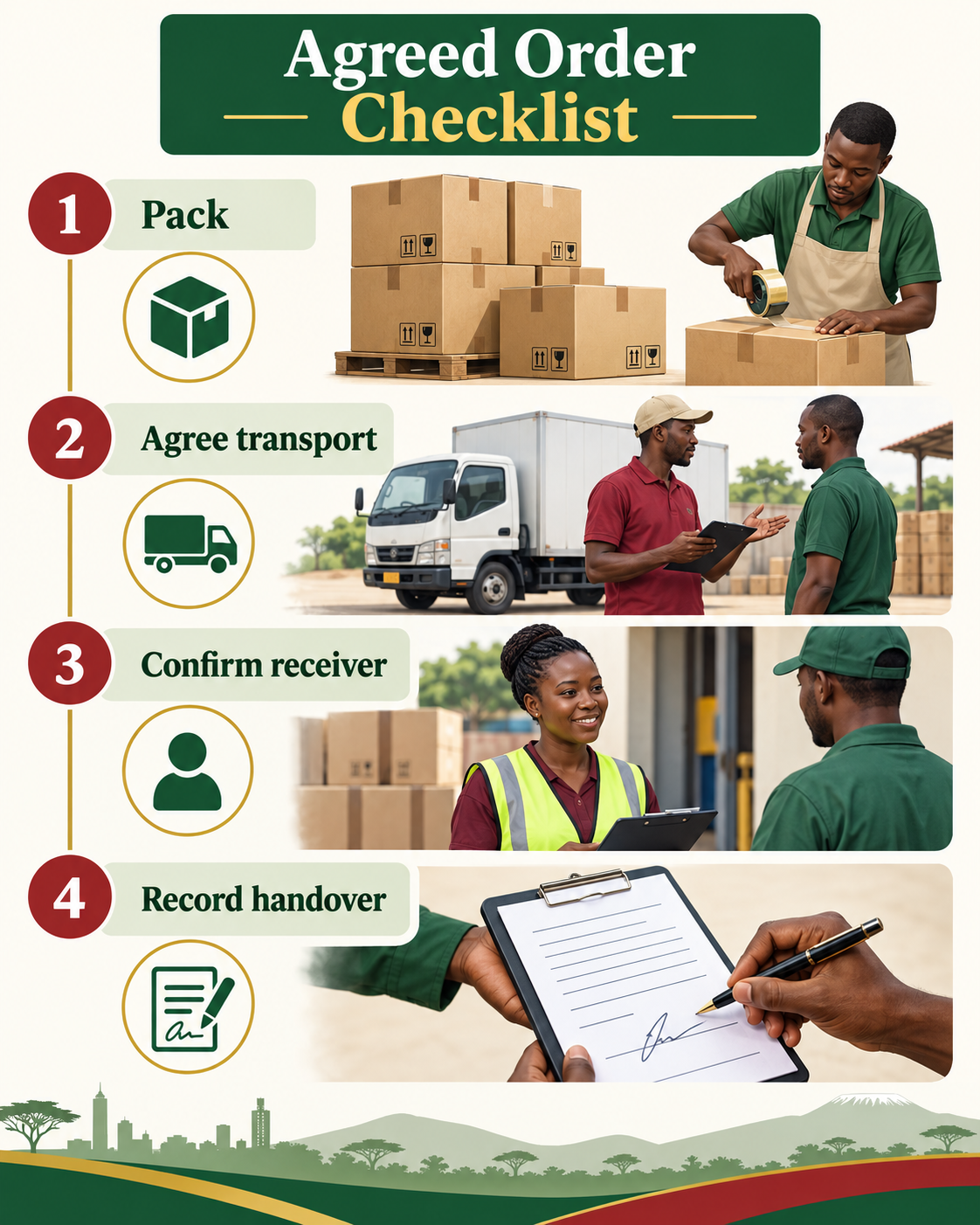
- Agree who books transport, pays the charge and communicates with the driver or carrier.
- Specify packaging, loading and unloading responsibilities, including any equipment or labour needed.
- Record the receiving contact, delivery location and documents needed when the goods arrive.
- Agree when responsibility for loss or damage passes and how shortages or damage should be reported.
9. Build trust through evidence and consistent follow-through
Buyers need reasons to believe that the product described is the product they will receive. Accurate photographs, consistent business details and relevant documents help them assess your offer. However, appearing on a marketplace should not be described as a blanket guarantee of quality, financial strength or compliance.
Check the standards and approvals that apply to your product category. The Kenya Bureau of Standards is an official starting point for information about standards and certification. If you display a certification mark or make a compliance claim, ensure that it is valid and relevant to the specific product.
Keep evidence organised around each order: the accepted specification, quotation, approved changes, payment records and dispatch documents. Share only the information needed for the transaction, and protect personal and commercial details. Good records help both parties resolve questions without relying on memory or searching through unrelated messages.
Agree what happens if goods arrive damaged, quantities differ or the product does not match the accepted specification. Define the reporting route and the evidence needed, such as photographs and delivery notes. Avoid making broad return promises for customised goods without considering the actual agreement and applicable legal obligations.
After fulfilment, ask whether the goods matched the agreed requirement and what should change next time. Seek permission before publishing a customer name, testimonial or photograph. A seller builds credibility through repeated, verifiable actions, not through exaggerated claims about reach or guaranteed success.
“Make the promise clear enough that both the buyer and the manufacturer can check whether it has been kept.”— Dr. Chomba Chuma, Founder, Viwanda — editorial view
10. Use completed orders to improve your next wholesale sale
Digital selling becomes more useful when you learn from the work behind each order. Keep a simple enquiry register showing the requested product, quantity, stage and next action. Record why a discussion stalled where the buyer tells you. Do not assume that every unanswered quotation was rejected because of price.
Review the questions buyers repeatedly ask. If several customers need carton dimensions, add that information to your product material. If they misunderstand your minimum quantity, rewrite it. Better information will not guarantee sales, but it can reduce avoidable clarification and help buyers judge whether your offer suits their needs.
Build relationships with buyers whose requirements match your capacity. You can explore Viwanda's manufacturer pages and distributor pages to understand the marketplace context. Do not imply that visiting these pages automatically creates a partnership, gives access to private contacts or secures a distribution agreement.
For an enquiry from outside Kenya, treat export readiness as a separate assessment. Confirm destination requirements, documentation, payment currency, transport and responsibility for customs procedures before quoting. Being listed online does not automatically make a product export-ready, and a domestic delivery arrangement should not be assumed to cover cross-border trade.
Start with a manageable range of products that you can describe and supply reliably. Gather your supplier information, choose the person who will handle enquiries and ask Viwanda about getting started. Request clarity on the arrangements that apply to your business, then build your wholesale process around promises you can keep.
Frequently asked questions
Can buyers check out online for every product on Viwanda?
No. Viwanda is currently enquiry-led wholesale, and online checkout exists only for items stocked by Viwanda. For other listed products, buyers should enquire and confirm specifications, availability, payment and fulfilment terms before treating the discussion as an order.
Can I list imported finished goods alongside Kenyan-made products?
Viwanda's marketplace is for Kenyan-made products only. If your business handles both local manufacturing and imported finished goods, separate the ranges when discussing onboarding. Ask the team what information is needed to establish whether your proposed products fit the marketplace.
Does paying by M-Pesa mean my order has escrow protection?
No. M-Pesa is a payment method; escrow is a separate arrangement for holding and releasing funds under agreed conditions. Confirm the payment route for your order, and do not assume escrow protection unless a specific arrangement and its written terms are provided.
Who arranges delivery for a wholesale order?
Confirm this for each transaction. Buyer collection, seller-arranged transport or another agreed arrangement may apply. Before dispatch, record the transport charge, handling responsibilities, receiving contact and process for reporting problems. A product listing alone does not establish who is responsible for delivery.
Ready to take the next step?
Viwanda makes it straightforward to buy Kenyan-made goods wholesale or reach serious business buyers.
Enquire about selling your Kenyan-made products