buyer guide · Kenyan manufacturing & compliance
What Rural Industrial Development Means for Kenyan Buyers and Sellers

What rural industrial development means in everyday business
By Dr. Chomba Chuma, Founder, Viwanda. Rural industrial development can sound like a government planning term. For a buyer or seller, however, it starts with something practical: making useful goods closer to the people, materials and skills involved in production, then connecting those goods to dependable markets.
Think of a workshop making furniture in a small town, a group stitching workwear near a farming community, or an enterprise processing locally grown produce. These businesses need more than machines. They need suitable premises, capable workers, reliable utilities, working capital and customers who understand what they can supply. Not every rural enterprise uses local raw materials, and not every locally available material is ready for commercial processing.
The important shift is from occasional production to a repeatable business. A maker should be able to explain what an item is, how it is made, what quality checks apply and when an order can realistically be ready. A buyer should be able to communicate requirements without assuming that a photograph tells the whole story.
For buyers, rural production can widen sourcing choices and create relationships with manufacturers outside familiar trading centres. For sellers, it can support value addition and access to customers beyond the immediate community. Neither outcome happens automatically. Distance, inconsistent inputs and limited storage can make otherwise promising orders difficult. This guide focuses on the decisions that turn local production into reliable trade, rather than treating a new factory building or a busy launch event as proof that a market already exists. The test is whether useful goods reach suitable customers repeatedly, with responsibilities understood and the business able to continue after the first sale.
Start with a production opportunity, not just an available material
An area may have timber, milk, fruit, fibre or skilled artisans, but availability alone does not establish a viable manufacturing business. The starting question is what a customer needs and whether local production can meet that need consistently. A resource becomes a commercial advantage only when its quality, cost and supply pattern suit the intended product.
A buyer considering a rural supplier should discuss the actual production process. Ask which activities happen at the site, which are outsourced and which inputs come from elsewhere. A furniture workshop may source fittings from a distant town. A garment producer may depend on fabric bought in advance. Those dependencies matter when agreeing order quantities or discussing possible changes.
Sellers should also separate their strongest current capability from what they hope to offer later. A small enterprise that makes one dependable product can be easier to work with than one promising a large catalogue without adequate equipment or supervision. Buyers can browse Kenyan-made products to explore categories, then enquire about suitability rather than assuming every listing matches their intended use.
- Define the customer and use: household furniture, school workwear and hospitality supplies can require different specifications even when the basic production skill is similar.
- Check input continuity: establish whether materials are available throughout the year, vary by season or require advance purchasing and suitable storage.
- Identify the production limit: drying space, cutting equipment, clean water, trained operators or packaging availability may constrain output more than demand does.
- Confirm practical economics: include preparation, rejected materials, packaging and movement to the collection point before deciding that a locally available input makes the product inexpensive.
Use aggregation to coordinate supply without hiding its source
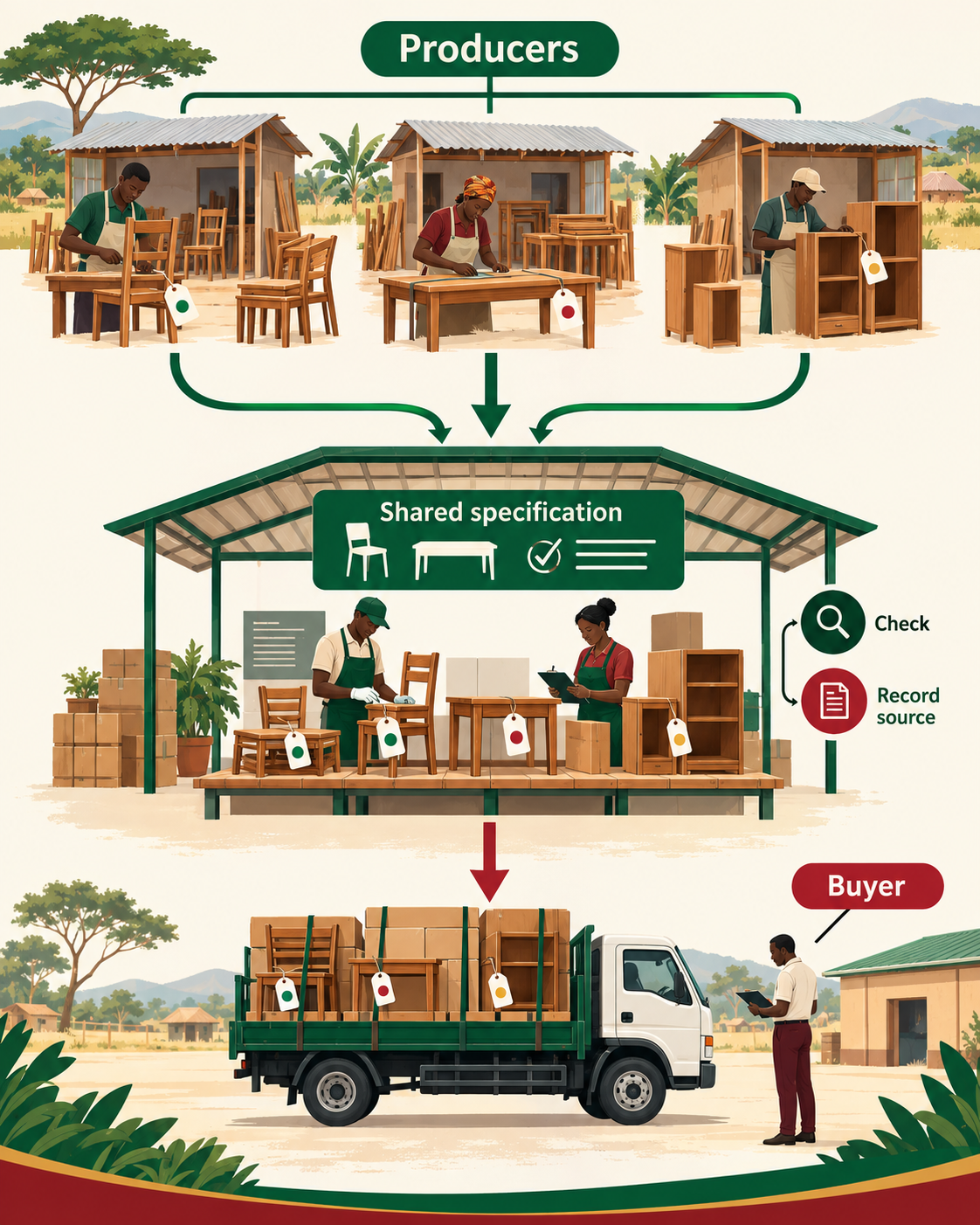
Aggregation brings output from several producers together so that buyers can access a more useful quantity through a coordinated arrangement. It may involve a cooperative, a private aggregator, a manufacturer buying components or a collection centre. Its value is not simply putting more goods in one store. It is making different contributions manageable for the customer.
Imagine several workshops supplying stools for a hospitality buyer. If their dimensions, finishes and construction differ, collecting them in one place does not create a consistent order. Someone must issue specifications, check samples, inspect incoming goods and separate anything that does not meet the agreed requirement. The aggregator needs authority to refuse unsuitable items, not just responsibility for dispatching them.
Buyers should establish who actually sells the finished goods and answers for a problem. Is the aggregator buying and reselling, or only introducing producers? Who issues the invoice, holds stock and approves replacements? Sellers need equal clarity about deductions, rejected goods and payment arrangements. An unclear intermediary can create confusion even when everyone begins with good intentions.
- Use a shared product description and approved reference sample where suitable, so participating producers work towards the same agreed result.
- Keep producer identities and relevant production records linked to incoming goods; combining a shipment should not erase useful information about its source.
- Set intake rules covering inspection, quantities, packaging and the handling of goods that arrive incomplete or outside the specification.
- Agree storage and release authority, including who may substitute products and who must obtain the buyer’s approval before making a change.
- Record producer payments and any agreed charges clearly, so coordination costs do not become unexplained deductions after goods have already been supplied.
Make quality and compliance part of the production plan
Rural location does not remove product obligations. The relevant requirements depend on the goods and activities involved, not whether the producer works in a village, a county town or an industrial estate. Buyers and sellers should establish applicable standards, certification, labelling and other approvals before committing to commercial supply. Requirements for food, furniture, garments and building products are not interchangeable.
KEBS is an important official starting point for understanding Kenyan product standards and certification. Depending on the activity, other regulators or county authorities may also have a role. Do not treat business registration, a county permit, a laboratory report and product certification as equivalent documents. Each can answer a different question. Where a document or mark is presented, check its scope and confirm relevant details through the issuing body's official channels.
Quality also includes the agreed commercial specification. A compliant item may still be unsuitable for a particular buyer because of its dimensions, finish, packaging or intended use. Write those requirements down in language the production team can follow. Use measurable descriptions where possible, and decide how samples will be approved. For some products, appearance alone cannot establish safety or performance; appropriate testing may be necessary.
Sellers should budget for compliance and quality controls as operating needs, not costs to consider only after receiving a large enquiry. Buyers should avoid asking producers to bypass necessary checks to meet an urgent order. If the applicable requirements are unclear, pause the affected commitment and seek guidance rather than relying on a familiar-looking label. A written specification, suitable inspection and properly checked regulatory evidence serve different purposes. Together, they make it easier to know what can be supplied responsibly.
“Buying locally should mean asking clear questions, not lowering the standard you expect.”— Dr. Chomba Chuma, Founder, Viwanda
Design logistics around the whole journey, including collection
The journey from a rural production site often starts before a truck reaches a main road. Goods may need collection from several workshops, movement to a shared store and protection while waiting for onward transport. A quotation that mentions transport without describing these stages can leave important responsibilities uncovered.
Buyers and sellers should map the route together. Consider road access, loading space, vehicle suitability, weather exposure and the receiving site's opening arrangements. Bulky furniture, fragile containers and products requiring controlled temperatures cannot all use the same transport plan. Where specialist handling is needed, establish whether a suitable provider is available before confirming the order.
Packaging should suit both the product and the journey. An item that survives a short movement within a workshop may not withstand repeated loading or a rough collection route. Discuss stacking, moisture protection and whether mixed goods can travel together safely. Reusable crates or pallets also need an agreement on ownership, return and responsibility for loss. The objective is not elaborate packaging for its own sake, but protection that matches the actual risks.
Consolidating orders can make a journey more practical, but waiting for a full load may delay goods already completed. Agree how long items can wait, where they will be stored and who can authorise dispatch. State who arranges each transport stage and when responsibility for loss or damage changes. Buyers should share accurate delivery instructions; sellers should confirm readiness before a vehicle is sent. If access changes because of rain or local road works, communicate early and agree a revised plan. A transport arrangement is useful only when both sides understand its assumptions and know whom to contact when those assumptions fail.
Build a working agreement before scaling the relationship
A rural supply relationship becomes easier to manage when both parties can explain the order in the same way. That does not require complicated paperwork for every transaction. It does require a written record that covers the product, responsible parties, payment arrangement and practical conditions for fulfilment.
Avoid an open-ended promise to buy everything a producer makes or supply whatever a buyer requests. Those commitments can push a small enterprise into unsuitable material purchases or leave a customer waiting for goods that cannot be completed. Start with a clearly bounded order and review actual performance before expanding the arrangement.
The following sequence helps turn a promising conversation into a manageable commercial relationship. It is especially useful where a producer, aggregator and transport provider all participate. Keep the current agreed version accessible to everyone who needs it, rather than leaving important changes scattered across private messages.
- Identify the parties and their roles. Record who manufactures, who sells, who collects payment and who is authorised to approve changes or resolve a complaint.
- Confirm the product specification. Include the relevant version, materials, measurements, packaging and compliance evidence, alongside any approved sample and its agreed limitations.
- Check capacity against the proposed order. Discuss input availability, production commitments, inspection needs and collection arrangements before agreeing a realistic readiness date.
- Agree commercial responsibilities. Record payment stages, included services, applicable charges and what happens if quantities, specifications or collection arrangements change.
- Set acceptance and problem-handling rules. Explain how goods will be checked, how concerns should be reported and who decides on correction or replacement.
- Review the completed order together. Compare what was agreed with what happened, resolve outstanding issues and change the next order only where the evidence supports it.
Turn market access into clear, useful product information
Market access is more than being visible online or attending a trade fair. A potential customer needs enough accurate information to decide whether to enquire. A rural producer with excellent workmanship can still lose suitable buyers if product descriptions are vague, photographs are unclear or messages go unanswered.
Prepare information that answers practical buying questions. Describe materials, dimensions, intended use, available variations, packaging and the conditions that affect order size. Distinguish standard products from work made to a buyer's specification. Use photographs of actual products and explain when an image shows a sample rather than an item ready for supply. Claims about origin, durability or special performance should have a sound basis.
Buyers can use manufacturer information to explore possible supply relationships and distributor information when considering a route to market. These are starting points for discussion, not substitutes for checking suitability. A distributor may offer market knowledge and access to customers, but responsibilities for stock, representation and after-sales concerns still need agreement.
Viwanda is currently an enquiry-led wholesale marketplace for Kenyan-made products only. Buyers use enquiries to discuss availability, quantities and order requirements. Online checkout exists only for items stocked by Viwanda; it should not be assumed to apply to every listed product. Sellers therefore benefit from responding with specific, current information rather than general assurances. Buyers can also help by stating the intended use and destination early. You can see how Viwanda works before beginning a sourcing conversation. Digital visibility can shorten the search for a suitable connection, but dependable production, checked requirements and clear communication are what make that connection commercially useful. Neither a listing nor a busy inbox guarantees a completed order.
Choose shared facilities that solve a real business problem
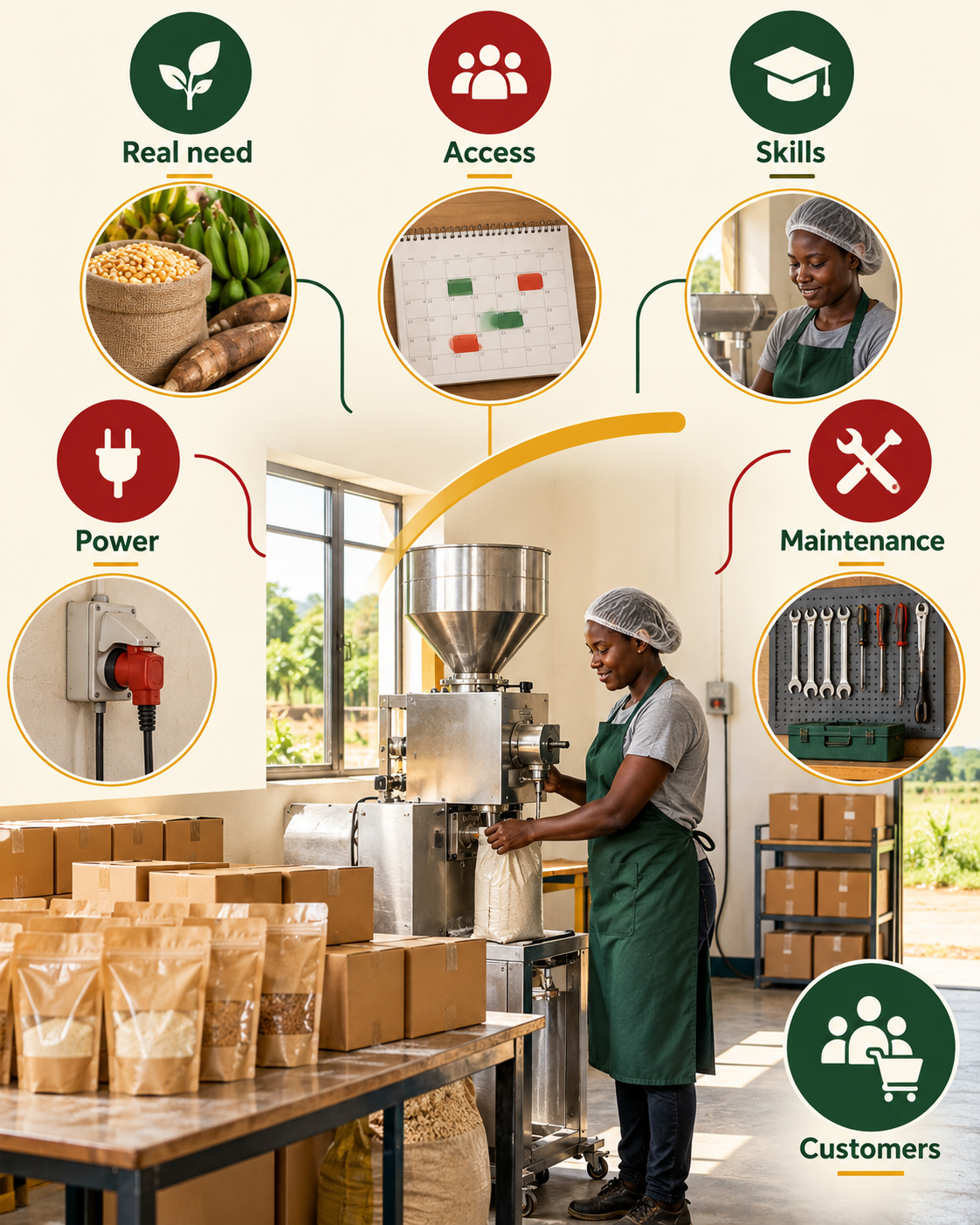
Shared facilities can help rural enterprises access services they cannot sensibly provide alone. Depending on the product, these might include drying space, appropriate processing equipment, secure storage or a coordinated collection point. However, the existence of a building or machine does not tell a buyer whether it is operational or suitable.
Ask what problem the facility solves and how it is managed. Who schedules access, maintains equipment and pays for utilities? Are operators trained? How are different customers' goods separated? What happens during a breakdown? Where production involves food or other sensitive goods, hygiene and contamination controls need particular attention. Shared use should not weaken the controls each product requires.
Buyers should also check whether the producer actually has access when the order needs it. A shared machine may be fully booked, or access may depend on fees that have not been included in the producer's plan. Sellers should avoid accepting orders on the assumption that equipment will be available simply because it is nearby. Confirm the arrangement before making a commitment.
When evaluating a local industrial initiative, focus on operational evidence rather than promotional language. Are businesses using it repeatedly? Can operators explain maintenance arrangements? Are goods moving to identifiable customers? Has the facility reduced a specific production constraint without creating an unmanageable new expense? For official context, the Kenya National Bureau of Statistics publishes economic information, while the Kenya Association of Manufacturers provides manufacturing-sector resources. Neither replaces a site-specific assessment. A modest, well-run collection store can be more useful to a particular supply chain than an impressive facility that lacks power, staff or customers. The right investment is the one that supports a demonstrated need and has a workable plan for continued operation.
Measure progress through reliable trade, then take the next step
For a buyer, the practical test of rural industrial development is whether a supplier can fulfil a suitable order consistently. For a seller, it is whether production leads to business that covers its obligations and can be repeated. Local employment and stronger commercial activity matter, but the trading relationship still needs to work for the people financing and delivering it.
Keep a simple review record after each order. Note whether goods met the agreed specification, whether documents were complete, what caused any delay and how concerns were resolved. Look for recurring problems rather than treating every incident as unrelated. If packaging repeatedly fails during collection, for example, the answer may be a different pack or handling method rather than another reminder to be careful.
Sellers should review whether the customer relationship fits their business. Frequent last-minute changes, unclear approvals or long waits for collection can disrupt a small production operation. Buyers should review whether the supplier communicates difficulties early and follows through on agreed corrections. Growth should follow demonstrated ability, not pressure to make the next order much larger. Sometimes the sensible next step is the same quantity with a better process.
If you are sourcing Kenyan-made products, begin with a focused requirement: the item, intended use, quantity, destination and any essential specification. If you manufacture, describe what you can produce reliably today and the information you need before accepting an order. Send Viwanda a wholesale enquiry to start that conversation. Availability, pricing, fulfilment arrangements and timing need confirmation for the particular order. Rural industry grows stronger when each new connection rests on clear information, realistic commitments and goods that serve the customer's actual needs.
Frequently asked questions
Does rural industrial development mean building large factories?
No. It can include small workshops, processing enterprises and shared services that help businesses produce reliably. The appropriate scale depends on the product, demand, infrastructure and operating costs. A larger facility is not automatically better; it needs capable management, suitable inputs and customers whose requirements it can meet.
Can several rural producers supply one wholesale order?
Yes, provided there is a clear coordination arrangement. Producers need agreed specifications, suitable quality checks and a responsible party who can answer the buyer's questions. Aggregation should preserve relevant source information. Before ordering, confirm who sells the goods, issues documents, receives payment and handles anything that falls outside the agreement.
Do rural manufacturers have different product compliance obligations?
Rural location is not, by itself, an exemption from applicable requirements. Obligations depend on the product and activity. Confirm relevant standards, certification, labelling and approvals through official bodies such as KEBS and other responsible authorities. Do not assume that a business permit establishes product compliance or that one certificate covers every item.
How can I start sourcing rural-made products through Viwanda?
Browse relevant Kenyan-made products and submit an enquiry describing your quantity, intended use, destination and essential specifications. Viwanda is enquiry-led wholesale, so availability and order arrangements require confirmation. Online checkout is available only for items stocked by Viwanda. A useful first enquiry explains your requirements without assuming a price or delivery date.
Ready to take the next step?
Viwanda makes it straightforward to buy Kenyan-made goods wholesale or reach serious business buyers.
Start your Kenyan-made wholesale enquiry