seller guide · Kenyan manufacturing & compliance
How B2B Marketplaces Support Kenya’s Industrial Growth

What a marketplace can realistically contribute to industrial growth
By Dr. Chomba Chuma, Founder, Viwanda. Industrial growth begins with businesses making useful products consistently and finding customers who can buy them. For a Kenyan manufacturer, that means more than installing equipment. It means understanding buyers, meeting applicable requirements, organising production and getting paid in a way that keeps the business running.
A business-to-business marketplace can help connect some of these activities. It gives manufacturers another place to present their products and gives retailers, distributors and institutional buyers another way to find local supply. This can reduce the effort involved in discovering a suitable business, especially beyond existing personal networks.
However, a listing does not create factory capacity, guarantee product quality or turn every enquiry into an order. Better visibility only becomes commercially useful when the seller responds clearly and can fulfil the agreed requirement. Industrial growth also depends on factors outside a marketplace, including infrastructure, skills, finance and predictable business conditions.
The sensible question is therefore not whether a digital platform can transform manufacturing by itself. It is whether the platform helps real businesses trade with less confusion and more useful information. That contribution should be judged through completed transactions, repeat buying and improvements in business processes, not simply the number of products displayed.
For a small producer, even a better organised route to buyers can be valuable. A workshop that previously depended on passing customers may begin receiving relevant enquiries from other towns. But the outcome must still be tested: did those enquiries become viable orders, and could the workshop serve them without weakening its finances?
“A marketplace supports manufacturing when it helps a real buyer and a reliable producer take the next practical step towards trade.”— Dr. Chomba Chuma, Founder, Viwanda
Digital distribution extends reach without replacing physical distribution
Many Kenyan sellers build their businesses through relationships, referrals, shop visits and phone conversations. These channels remain important. Digital distribution adds a searchable point of discovery, where a buyer can learn what a manufacturer makes before deciding whether to call, send an enquiry or request a detailed quotation.
This matters because a good product can remain commercially invisible outside its immediate area. A retailer seeking locally made cleaning products or a distributor looking for household goods may not know which factory to approach. A clear listing can bring the product into consideration without requiring the buyer to visit every industrial area.
Useful visibility depends on the quality of the information presented. A product name and attractive photograph are rarely enough for wholesale decisions. Buyers need to understand what is being offered, the unit of sale and which details require confirmation. Sellers should make differences between individual units, packs and cartons especially clear.
- Describe the product, intended use, material or formulation details where relevant, and available variants.
- State the wholesale unit clearly, including how individual items are grouped for ordering.
- Explain which order quantities, production arrangements and delivery terms require a direct discussion.
- Use accurate photographs that show the actual product rather than an unrelated example.
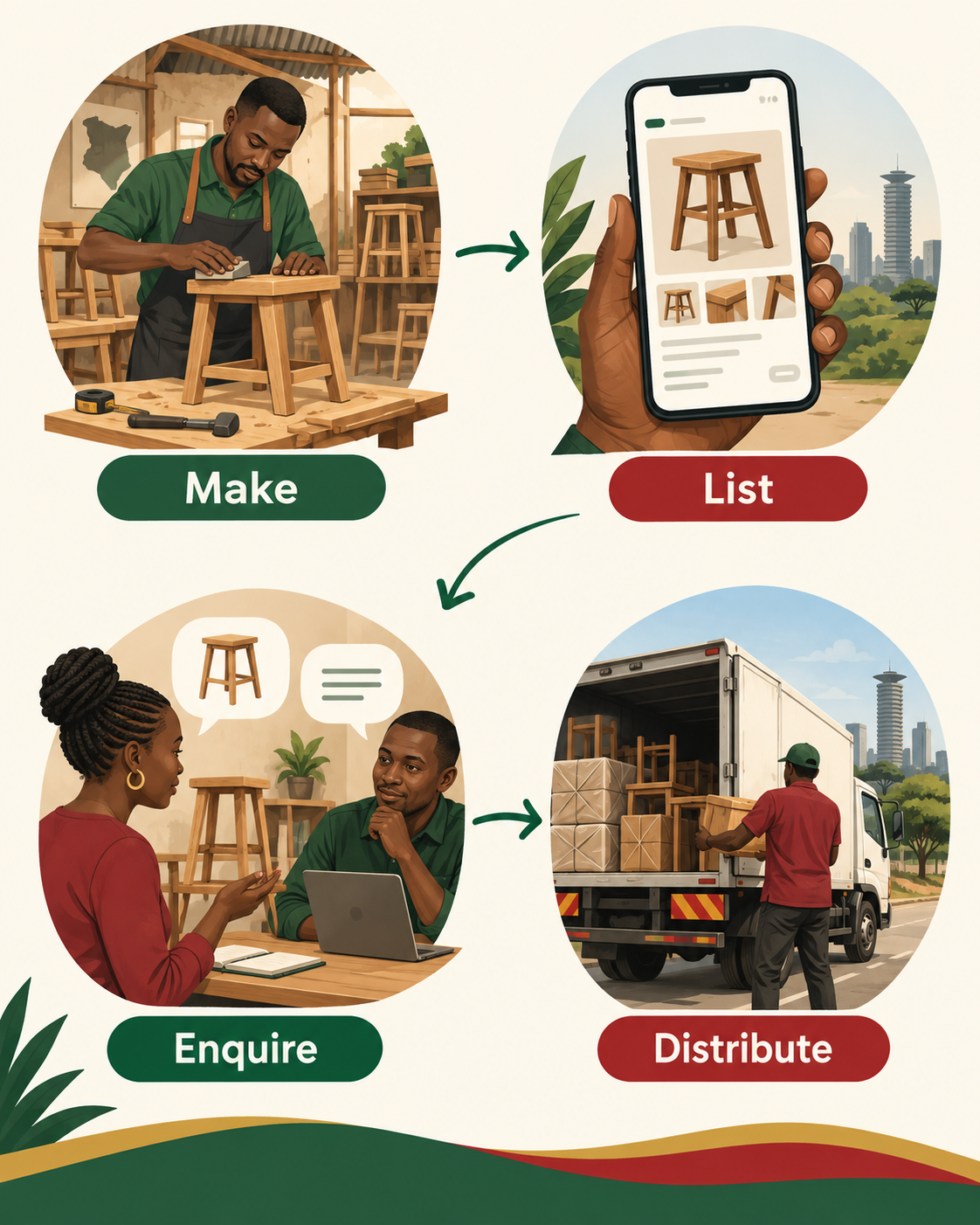
Demand visibility helps factories ask better production questions
Manufacturers often hear fragments of market demand through sales representatives, distributors and occasional customer calls. Marketplace enquiries can add another source of information. Buyers may repeatedly ask for a different pack size, a specific material or supply into a location the manufacturer has not previously served.
These signals are useful, but they are not the same as confirmed demand. One buyer may contact several suppliers, enquire before securing funding or abandon a planned purchase. A seller who treats every message as an order risks producing stock that has no committed customer. Record the interest, then establish how serious and practical it is.
A simple enquiry register can capture the product requested, buyer type, destination, approximate quantity and reason the discussion did not progress. Over time, it may reveal patterns that memory misses. For example, repeated requests for smaller wholesale packs may justify testing a new pack configuration rather than changing the entire production plan.
Interpret these records alongside actual sales, returns, production constraints and customer feedback. Online enquiries reflect the people using that channel, not the whole Kenyan market. Seasonal projects or a single large buyer can also distort the picture. A useful signal should prompt a question and a small test, not an automatic expansion decision.
At Viwanda, the responsible approach is to describe this as an opportunity for better learning, not proof that the platform has already increased industrial output. Sellers can explore how Viwanda works and decide how enquiries fit their existing sales process. The practical goal is clearer conversations between demand and production, with commitments confirmed before resources are tied up. Keep records consistent so comparisons remain meaningful from one month to the next.
Trust grows through evidence, not just a polished listing
Wholesale buying involves several kinds of uncertainty. A buyer wants to know whether the business exists, whether the product matches its description and whether the seller can supply the required quantity. A manufacturer also needs confidence that the buyer understands the order and will honour the agreed payment arrangement.
A marketplace can make relevant information easier to present and exchange. It cannot remove every commercial risk. Business identity, product compliance and ability to fulfil an order are separate questions. Evidence that answers one question should not be presented as if it answers all three.
For Kenyan-made goods, applicable requirements depend on the product and activity. KEBS is an important official starting point for information about standards and product certification. Sellers should check the requirements that apply to their own goods, rather than assuming that a competitor’s documentation or a general business registration is sufficient.
- Keep business names and contact details consistent across listings, quotations and transaction documents.
- Describe certification accurately, including its scope, rather than using broad claims such as fully approved.
- Make relevant product specifications and supporting records available through an appropriate exchange.
- Confirm changes to products, packaging or production arrangements before buyers rely on outdated information.
Compliance information should travel with the product
Compliance becomes more useful when it is part of everyday selling rather than a file opened only when a problem occurs. A manufacturer should know which claims can be supported, which documents are current and who is responsible for answering technical questions. This reduces contradictory answers from different members of the sales team.
The information required will vary. A food product, a cleaning chemical and a furniture item do not necessarily follow the same rules. Labels, safety information, testing, certification and sector approvals may be relevant in different combinations. Where the position is unclear, consult the appropriate authority or a qualified adviser before making a public claim.
Digital listings also need maintenance. If a pack changes, an old photograph can confuse a retailer ordering for a specific shelf space. If a specification changes, an earlier quotation may no longer describe the current product. Assign someone to check that the listing, quotation template and actual goods tell the same story.
Tax records belong in this conversation too. Sellers should consult KRA guidance on invoicing and applicable eTIMS obligations, including any relevant exceptions or approved arrangements. A marketplace enquiry or payment message is not automatically a compliant tax invoice. The business must understand which documents it needs to issue and retain for its circumstances.
The benefit is practical: a buyer can compare offers more accurately, and the seller spends less time correcting misunderstandings. Consistent records can also support traceability when a question arises about a particular supply. Avoid publishing sensitive documents unnecessarily; share what is relevant, protect personal information and keep more detailed records securely within the business. Review access when staff responsibilities change or an outside sales agent stops representing your products.
Clear payment arrangements turn interest into workable business
Finding a buyer is only part of a sale. The manufacturer must also agree how the order will be funded and when money will become available. An attractive order can still strain a business if materials must be purchased long before payment, especially where the goods are customised or difficult to resell.
Digital payment methods can make settlement and record keeping more convenient, but convenience is not the same as protection. Confirm the correct recipient, the payment reference and the amount received through the seller’s own account records. A screenshot supplied by another person should not be the only evidence used to release goods.
Agree the payment stages in writing before production or dispatch. Depending on the transaction, the discussion may cover a deposit, balance payment, agreed credit terms or payment after specified checks. None of these arrangements is automatically right for every buyer. The seller should consider its costs, working capital and ability to absorb a delay.
Payment records should connect to the quotation, accepted order and relevant invoice. This is especially important where one customer has several open orders or sends money in instalments. Clear references help both parties resolve questions without searching through unrelated messages. They also reduce the chance that money intended for one order is allocated to another.
Viwanda is currently enquiry-led wholesale for Kenyan-made products. Online checkout is available only for items stocked by Viwanda. For other enquiries, buyers should confirm the transaction process and payment terms for the specific offer. Do not assume that every listing includes platform payment processing, credit, escrow or a payment guarantee. Check who is receiving the money and what obligations each party has before making a commitment.
Build a repeatable process from enquiry to confirmed order
The value of digital distribution is easily lost when enquiries sit unanswered or move between staff without ownership. A small manufacturer does not need complicated software to improve this. A shared register, clear responsibility and consistent quotation format can make the sales process easier to manage.
Start by separating initial interest from an order ready for acceptance. A request for a catalogue needs a different response from a buyer who has specified quantities and a delivery location. Ask useful questions without overwhelming the buyer, and keep a record that another authorised colleague can understand.
The following process helps turn a marketplace contact into a properly defined commercial discussion. It is a working routine, not a promise that every enquiry will convert. Where a request does not fit your capacity or product range, say so early and clearly.
- Record the request. Capture the buyer’s contact details, requested product, intended quantity and destination. Note the date and assign a person to follow up.
- Clarify the requirement. Confirm pack sizes, variants, intended use where relevant and whether the buyer needs available stock or a production run.
- Check internal readiness. Ask production and finance colleagues about capacity, materials and payment needs before offering terms that the business may struggle to meet.
- Send a clear quotation. Identify the product, quantity, taxes where applicable, payment arrangement and delivery responsibilities. State the quotation’s validity and any conditions requiring confirmation.
- Obtain written acceptance. Resolve differences between the buyer’s request and your offer. Confirm the agreed terms before starting work that creates a financial commitment.
- Close the record properly. Link the outcome to the enquiry, whether it became an order or not. Record the reason and any appropriate follow-up action.
Measure business outcomes rather than digital attention
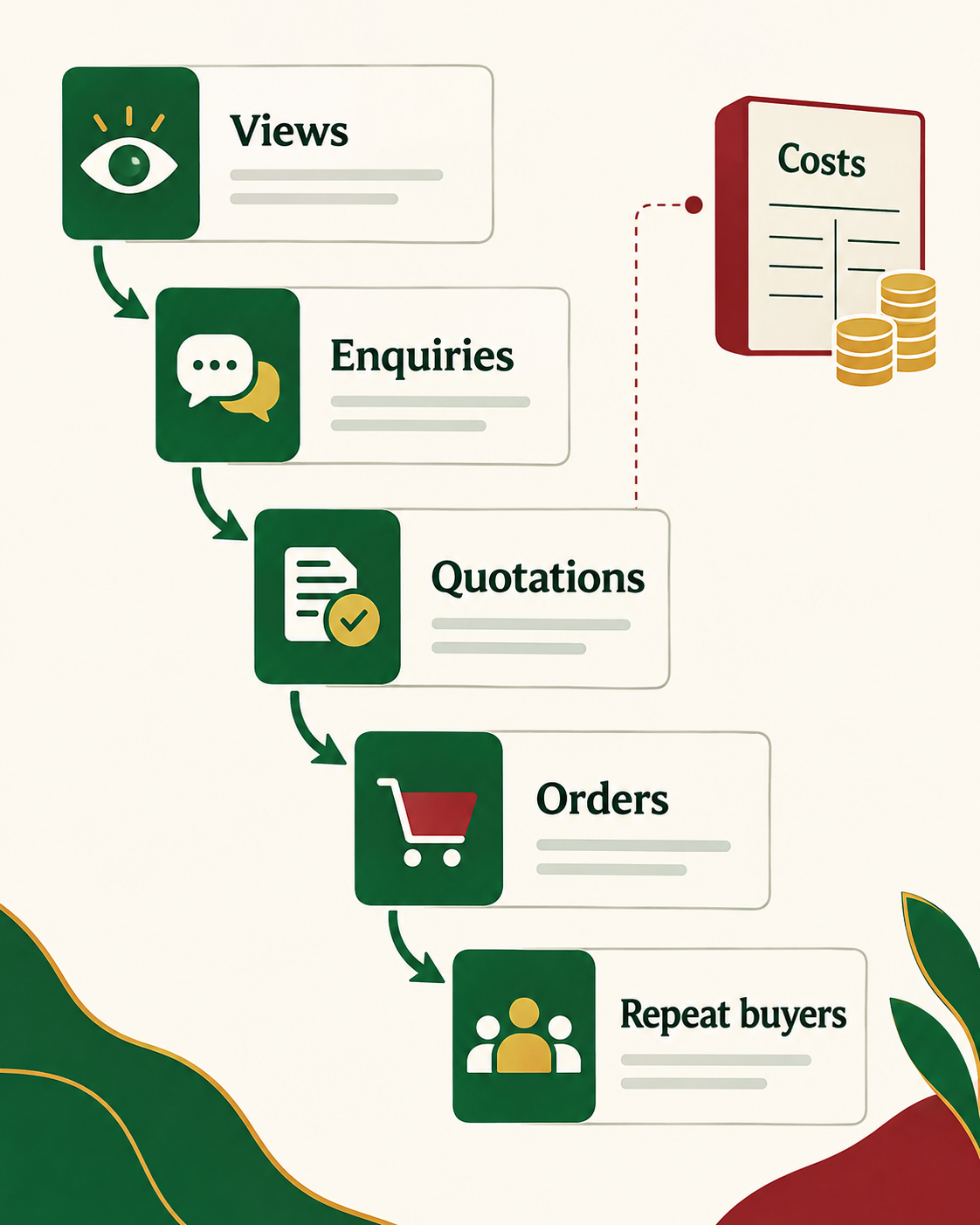
A platform can attract visits and still generate little useful business for a particular manufacturer. Page views and messages provide context, but they should not be confused with commercial progress. Sellers need a small set of measures that connects online activity to orders, margin and repeat relationships.
Begin with the number of relevant enquiries and how many progress to a quotation. Then track accepted orders and repeat purchases. Define these stages consistently: a relevant enquiry should contain a genuine product need, while an accepted order should have the confirmation your business requires. This makes comparisons more meaningful.
Look at quality as well as quantity. A modest number of well matched buyers may be more valuable than many requests for products you do not make. Review why opportunities are lost: the issue might be an unclear listing, unsuitable pack sizes, insufficient capacity or payment terms that do not work for either party.
Keep profitability in view. Revenue alone can hide the cost of samples, administration, packaging changes or small production batches. Compare orders on a sensible basis and avoid counting the same buyer twice because they used different contact channels. Digital distribution should support the business you want to build, not simply keep the phone busy.
For Viwanda, claims about industrial impact should require evidence beyond marketplace activity. More Kenyan-made listings or enquiries may show participation, but they do not by themselves prove additional factory output, employment or investment. Sellers can browse Kenyan-made products to understand how offers are presented, while keeping their own outcome records. Honest measurement helps the platform and participating businesses learn what needs improvement without overstating what has already been achieved.
Use the marketplace as one part of a stronger manufacturing network
Kenya’s industrial growth needs cooperation between manufacturers, distributors, retailers, service providers and public institutions. A marketplace can make some of those connections easier to start. Its strongest contribution is often practical: helping a buyer discover local supply and helping a producer understand what the buyer needs next.
That does not make established distribution relationships obsolete. Distributors can provide local market knowledge and physical access that an online listing cannot supply. Retailers understand how customers respond to products on the shelf. Manufacturers benefit when information from these relationships feeds back into product development, packaging and production decisions.
Sellers should therefore treat digital channels as an addition to a balanced route to market. Keep useful direct relationships, maintain accurate product information and choose orders that fit the business. If online interest grows faster than production capacity, improve planning before making commitments that damage buyer confidence.
The marketplace also needs limits that everyone understands. Viwanda focuses on Kenyan-made products and currently supports enquiry-led wholesale, with checkout only for items it stocks. That model can help begin commercial conversations, but the terms, availability and responsibilities for a specific order must still be confirmed. Visibility should open a door, not conceal the work required afterwards.
If you manufacture locally, start with one product range that you can describe and supply reliably. Prepare its specifications, relevant compliance information and a clear enquiry response process. Buyers and sellers can send a wholesale enquiry with the product, quantity and location involved. A useful next step is not a grand promise about transformation; it is a well defined conversation that gives both businesses enough information to decide whether they can trade.
Frequently asked questions
Does a B2B marketplace guarantee more sales for a manufacturer?
No. It can improve discovery and create opportunities for relevant enquiries, but sales depend on product fit, buyer readiness, clear terms and the seller’s ability to supply. Track accepted orders and repeat business rather than assuming that more listing views mean manufacturing growth.
Does a product listing prove that the goods meet Kenyan requirements?
No. A listing is not a substitute for applicable compliance evidence. Buyers should request relevant information, and manufacturers should confirm requirements with KEBS and any other responsible authority. Check that documents relate to the actual product and activity rather than relying on a broad approval claim.
Can buyers pay online for every product listed on Viwanda?
No. Viwanda is currently enquiry-led wholesale for Kenyan-made products. Online checkout exists only for items stocked by Viwanda. For other products, enquire first and confirm availability, the seller’s offer, payment arrangements and delivery responsibilities before committing funds or making plans based on the listing.
How can a small workshop use enquiry data without expensive software?
Start with a simple spreadsheet or register. Record the requested product, quantity, location, quotation status and final outcome. Review recurring requests alongside actual sales and production costs. Treat patterns as ideas to investigate, and test changes carefully before purchasing equipment or producing additional stock.
Ready to take the next step?
Viwanda makes it straightforward to buy Kenyan-made goods wholesale or reach serious business buyers.
Start a Kenyan-made wholesale enquiry